

This chart shows the working load limit (WLL) at the load hook for typical lifting configurations using EXE Rise chain hoists. Single-fall and double-fall reeves are listed alongside the practical lift height available at each rig height.
The numbers below are starting points - every hoist rig needs an engineer's load schedule that accounts for actual point distribution, chain weight at extended drops, and any derating that applies to your venue's roof structure. The chart is a quick sanity check, not a substitute for documentation.
Single-fall versus double-fall
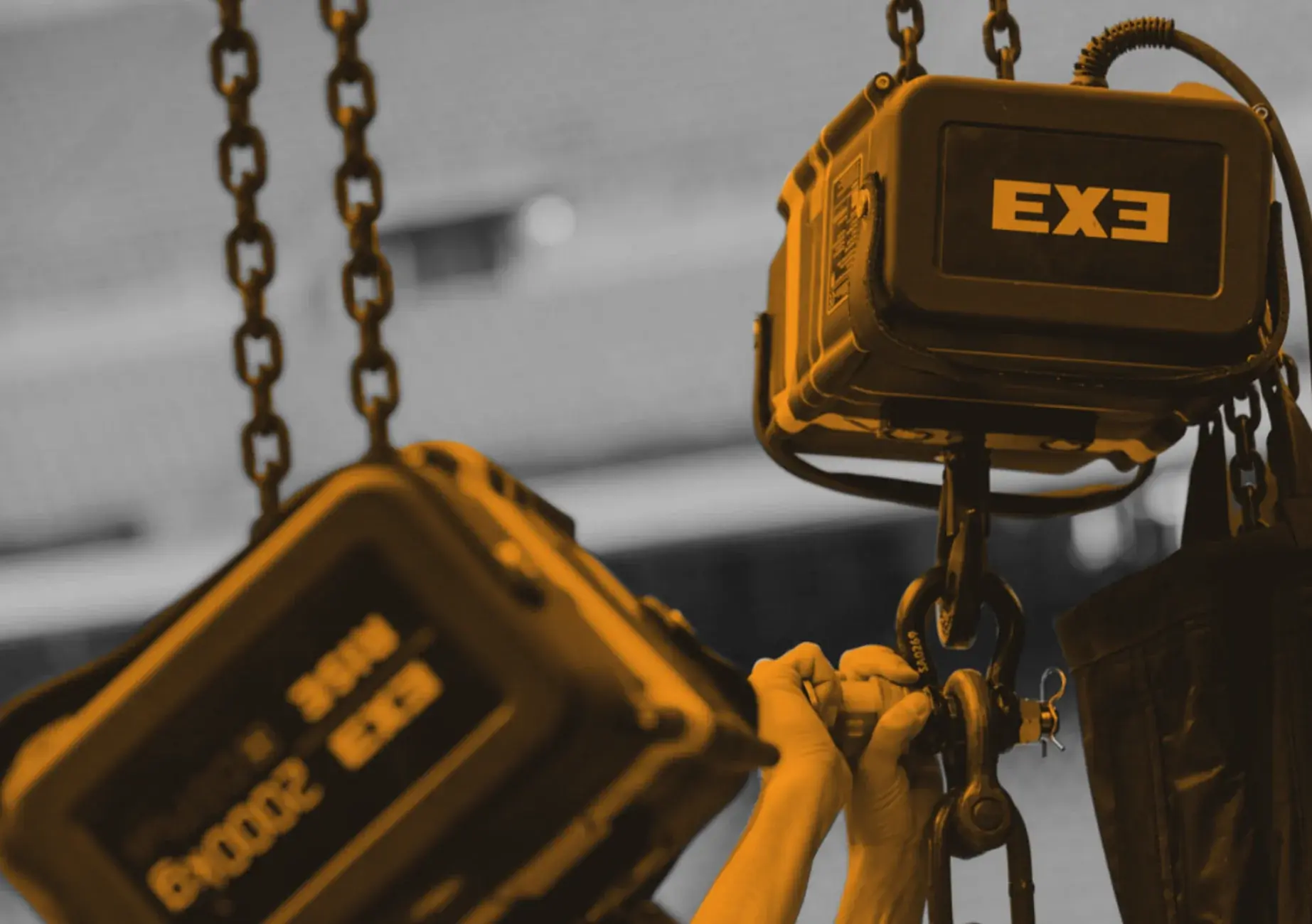
A single-fall reeve runs the chain directly from the hoist body to the load hook. WLL equals the hoist's rated capacity. A double-fall reeve loops the chain through a return sheave, halving travel speed but doubling the WLL at the hook. Most theatre fly applications run single-fall; double-fall is reserved for heavier scenic flying or performer-flying counterweight assists.
Standard WLL values, EXE Rise range
| Hoist model | Single fall WLL | Double fall WLL | Single fall speed | Double fall speed |
|---|---|---|---|---|
| EXE Rise 350 | 350 kg | 700 kg | 4 m/min | 2 m/min |
| EXE Rise 500 | 500 kg | 1000 kg | 4 m/min | 2 m/min |
| EXE Rise 1000 | 1000 kg | 2000 kg | 4 m/min | 2 m/min |
| EXE Rise 2000 (single reeve) | 2000 kg | - | 4 m/min | - |
| EXE Rise 2000 (double reeve) | - | 2000 kg | - | 2 m/min |
| EXE Rise 2500 | 2500 kg | - | 4 m/min | - |
Available lift at common rig heights
The practical lift drop reduces as rig height increases because the chain bag has to hold more chain. The table below shows usable lift for single-fall EXE Rise hoists at four common Australian PAC fly-tower heights.
| Rig height | 350 kg lift | 500 kg lift | 1000 kg lift | 2000 kg lift |
|---|---|---|---|---|
| 8 m grid | 7.5 m | 7.5 m | 7.4 m | 7.2 m |
| 10 m grid | 9.5 m | 9.5 m | 9.4 m | 9.2 m |
| 14 m grid | 13.5 m | 13.4 m | 13.2 m | 12.8 m |
| 18 m grid | 17.4 m | 17.3 m | 17 m | 16.5 m |
Derating factors to apply
Apply these multipliers to the values above when assessing a real configuration. They are cumulative - multiply through the line where more than one applies.
- Angled load (off-vertical pull): derate 15% per 10° off vertical. Beyond 30° off vertical, the hoist must not be used without engineered diversion sheaves.
- Continuous-duty use: derate 20% if the hoist is cycling on cue (performer flying, scenic moves) rather than holding static loads.
- Ambient temperature above 40°C: derate 10% for thermal margin on the motor.
- Group lift (multi-point pickup of a single load): derate the whole group to 80% of the rated capacity of the weakest hoist in the lift.
How to use this chart
For specifying a new rig, use the single-fall WLL column as your baseline and apply the derating factors to arrive at a working number. For checking an existing rig, work backward - measure the actual load, divide by the WLL, and confirm the result sits below 0.8 on every cue.
If you're sitting in front of a hoist rig right now and not sure whether the kit you have can take the load you need, call the TSA rigging team on 1300 439 872. We'll talk through it before you put a load on the hook.