

Steel weights in an arbor match whatever hangs on the bar. Balanced, the load moves by hand.
Guide · Rigging · Updated 17 Aug 2026
Theatre fly systems, explained. Counterweight, purchase and the lock.
A counterweight system lets one person move half a tonne of scenery by hand. How the balance works, how a line set is run, what to demand of powered flying gear before you buy it, and what the annual inspection grades.
- Fly systems
- 14 minute read
- For technical managers, mechanists & technical directors
Single purchase: arbor travels the same as the bar. Double purchase: half the travel, twice the arbor weight, wing space back.
Grip both lines, release the rope lock slowly, pause and confirm balance before you move anything.
Ask for 8:1, two independent brakes and a manual brake release. The load rating is the part everyone gets right.
A fly system almost never hurts anyone because it is heavy. It hurts someone because it is out of balance and nobody said so.
One bar, one arbor, and a balance you can feel.
A counterweight fly system is a balance, not a lift. Steel weights in a cradle match whatever hangs on the bar, so one operator can move several hundred kilograms through the full height of the fly tower with one hand on a rope.
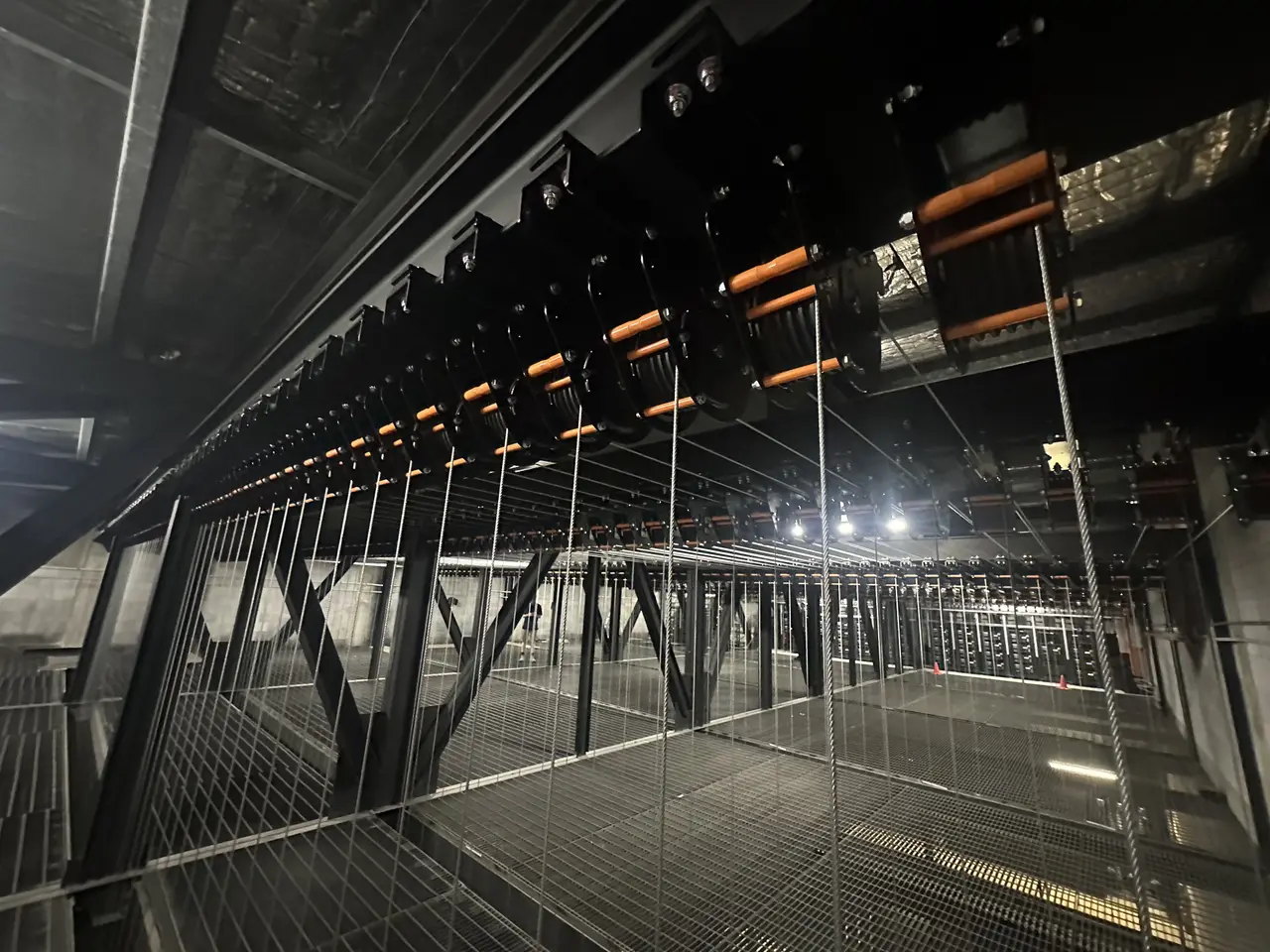
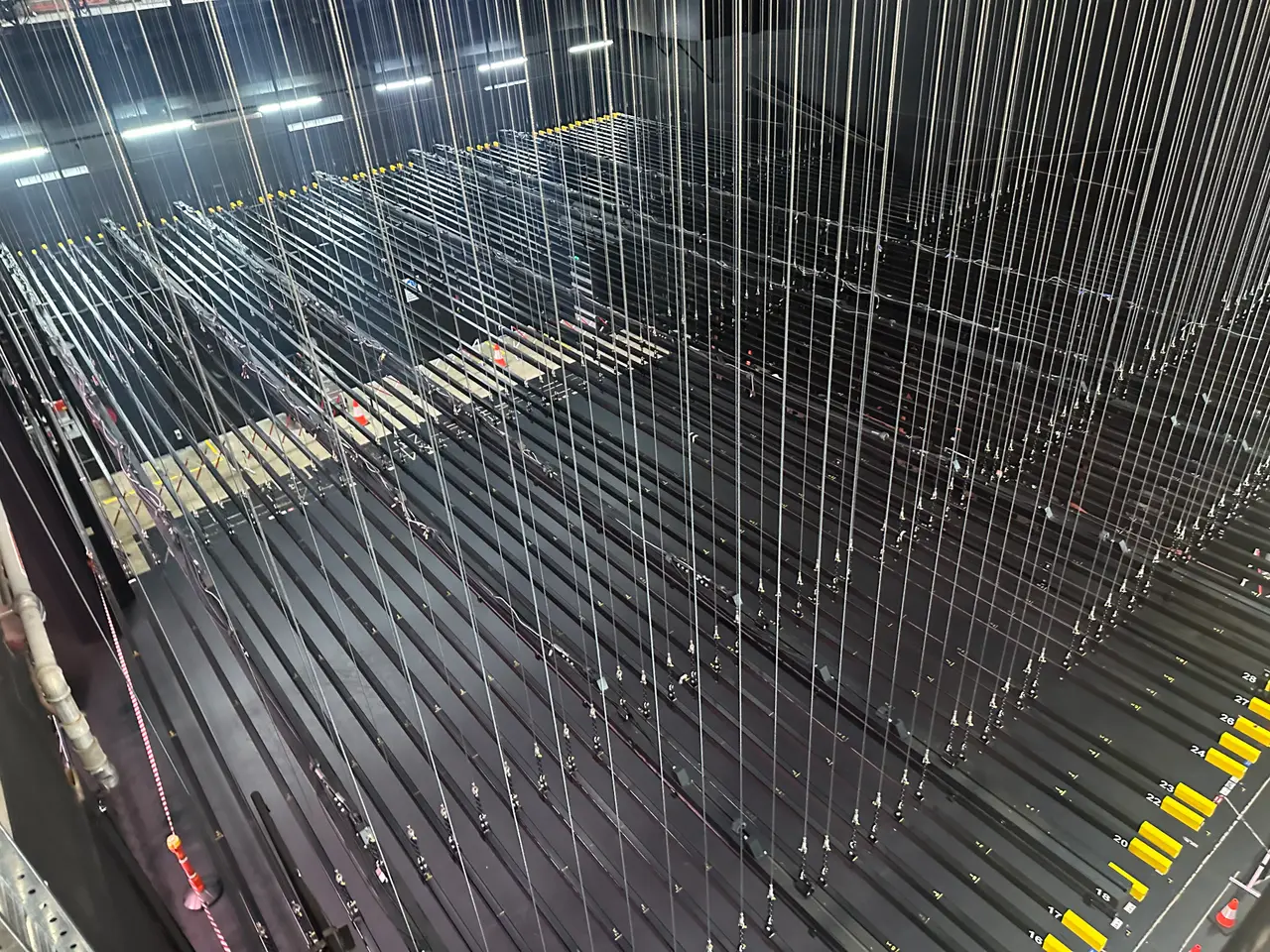
Follow one line set up from the stage. The batten is the horizontal pipe the load hangs from. Lift lines rise from it to the grid, over a loft block that turns each one horizontal, across to the head block (one multi-groove sheave that gathers the set and turns it back down), and end at the top of the arbor.
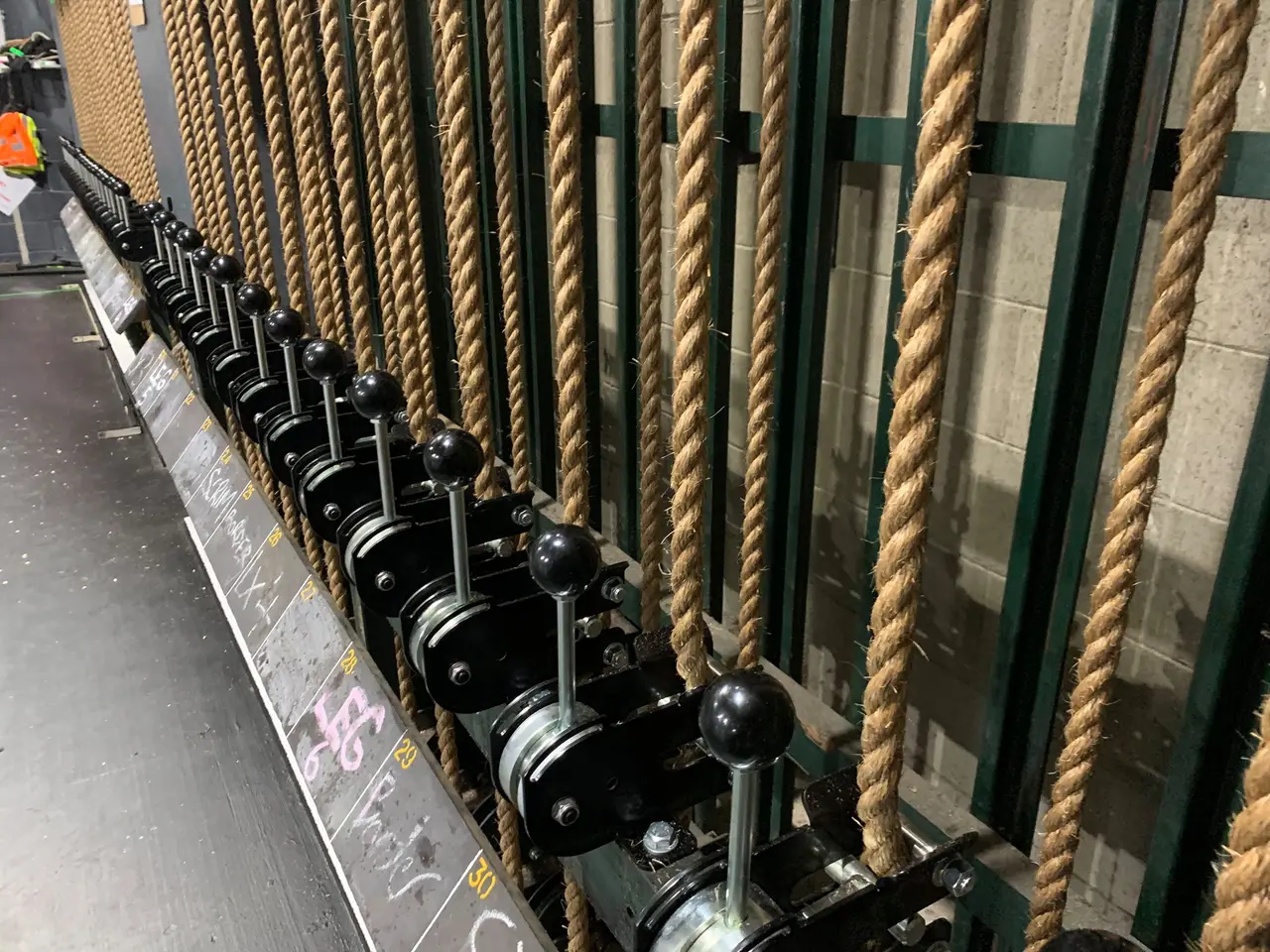
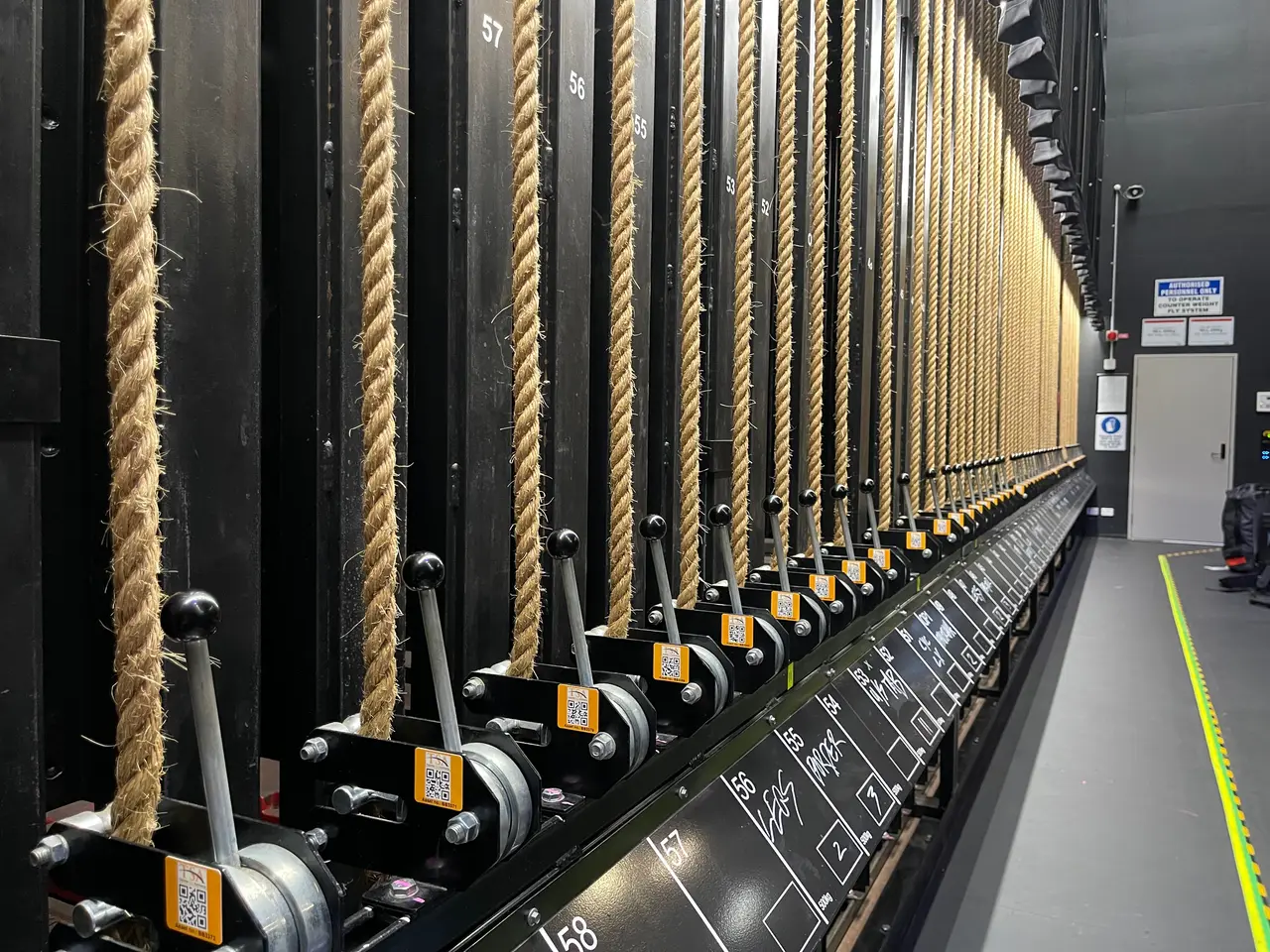
The arbor is a steel cradle in vertical tracks beside the wall, and it holds the counterweight stack. Lower-capacity systems may use guide wires instead of tracks. A continuous operating line runs from the top of the arbor, over the head block, down past the operator, round a tension block at floor level and back to the bottom of the arbor. A rope lock clamps it and holds a balanced set where it was left.
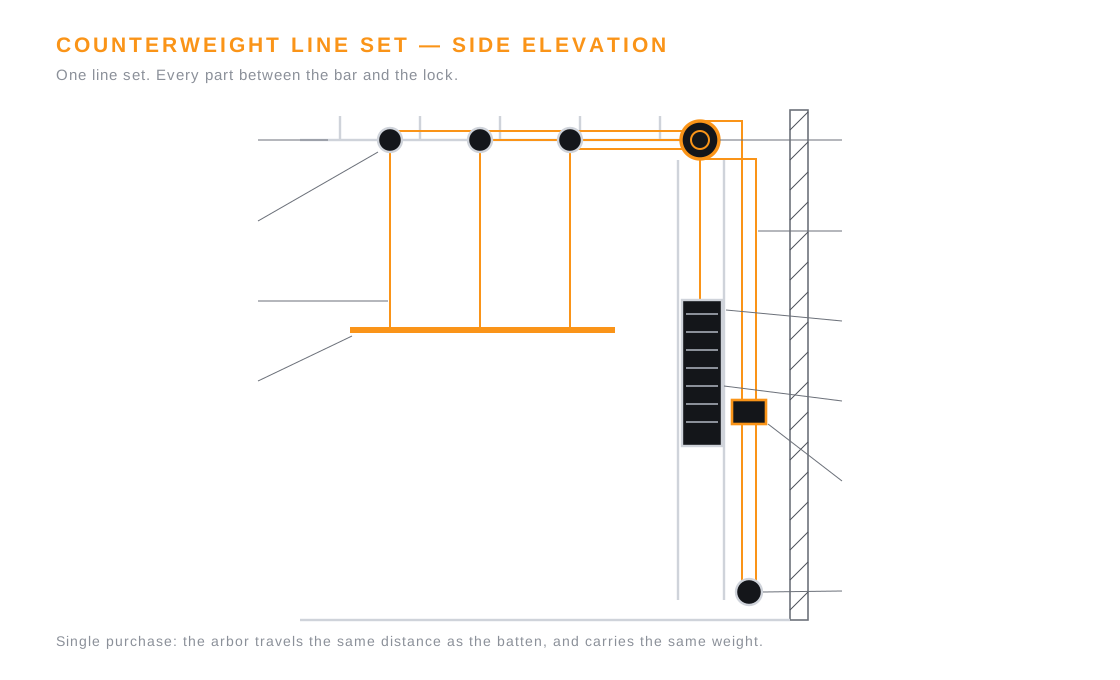
| Part | What it does | What goes wrong |
|---|---|---|
| Batten | The pipe the load attaches to, spanning most of the stage width. | Bowing, damaged splices, overloaded past the set's rated limit. |
| Lift lines | Steel wire ropes carrying the batten up to the grid. | Broken wires, corrosion, worn or incorrect terminations. |
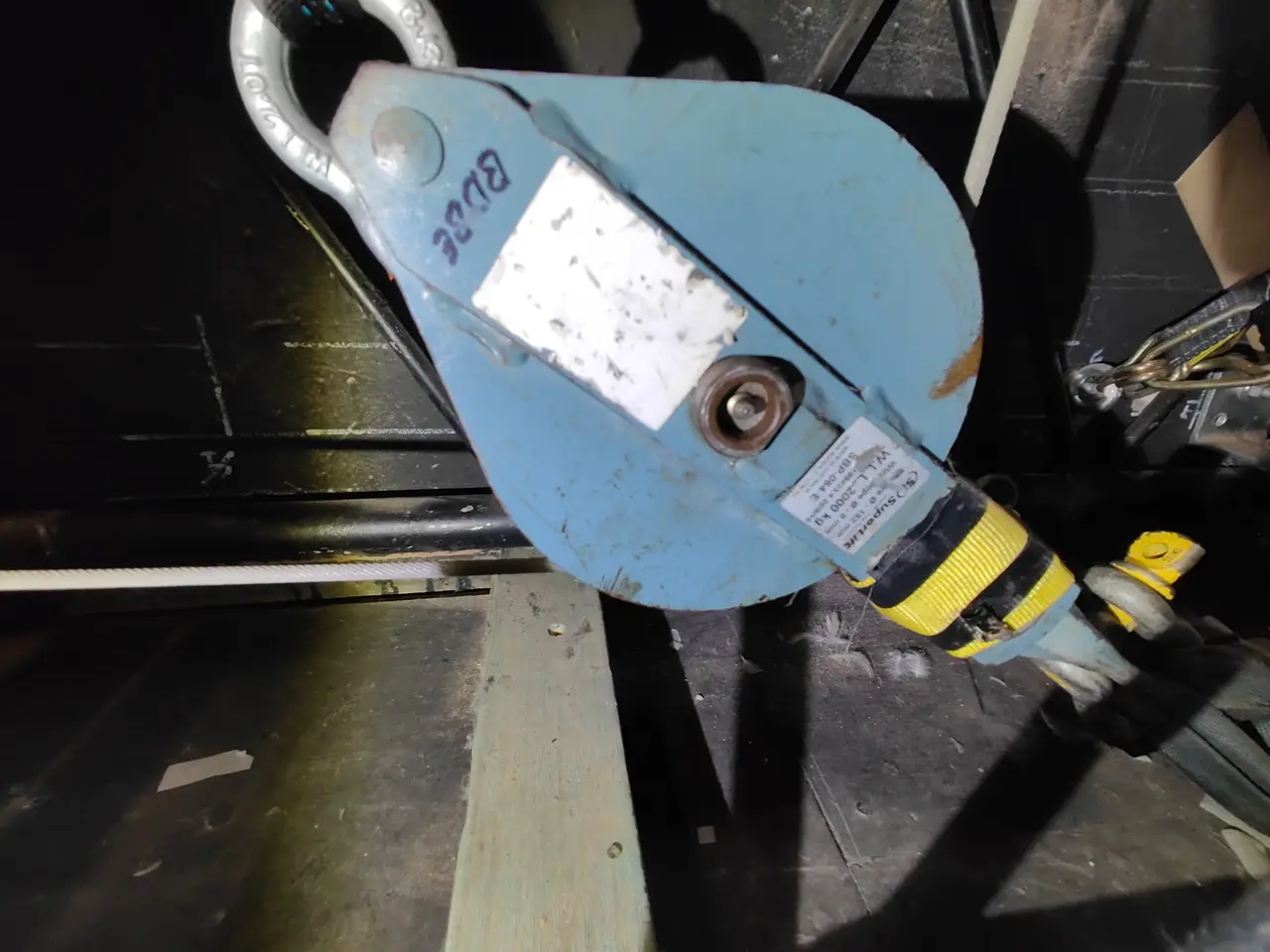
| Loft blocks | Grid sheaves turning each lift line from vertical to horizontal. | Worn grooves, seized bearings, poor fleet angle into the block. |
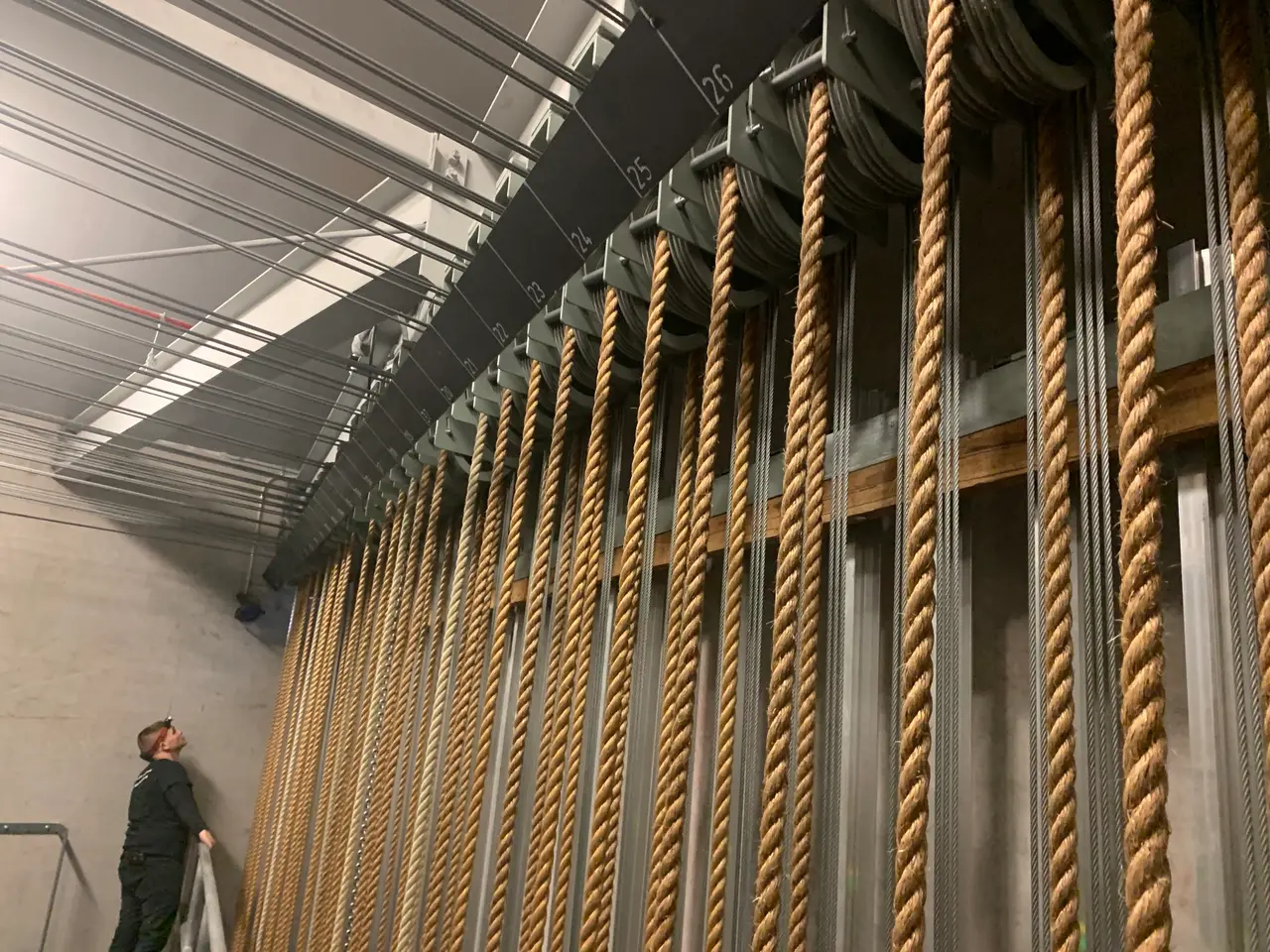
| Head block | Multi-groove sheave gathering the set and turning it down to the arbor. | Groove wear, rope jumping a groove, loose mounting steel. |
| Arbor (cradle) | Carries the counterweight stack and travels in guides beside the wall. | Missing or loose spreader plates, bent rods, worn guide shoes. |
| Operating line | The continuous rope the operator hauls on to drive the set. | Fraying, glazing, hard spots, damage from knots and ribbon marks. |
| Rope lock | Clamps the operating line and holds a balanced set in position. | Worn jaws, poor adjustment, used to hold an unbalanced set. |
| Tension block | Keeps the operating line under tension at the bottom of its run. | Seized sheave, lost tension, guard or capture missing. |
Some venues run without a counterweight in sight. A pile hoist or motorised set drives the bar on wire ropes from a winch, and an automated fly system runs it on cue. Most Australian venues mix the two: manual sets for bars that rarely change, motorised sets for the ones that move every show. See the fly systems page.
Single or double purchase. The trade is travel against space.
Purchase is how the lines are reeved between arbor and batten. It sets how far the arbor travels and how much weight it carries, so establish it first in any tower you are asked to work in.
In a single purchase system the arbor travels as far as the batten and carries the same weight. It is the most common build and the most direct to load. In a double purchase system the lines pass through a moving block, so the batten travels twice the arbor distance: arbor travel halves, the arbor carries twice the weight, and the wing space beneath it stays usable for cast, crew and scenery.
Double purchase buys wing space and pays for it in arbor weight.
That means twice the steel in the cradle for the same bar, slower loading and more weight on the loading gallery. Double purchase is chosen where the building forces it: limited fly height or wing space, or a tower retrofitted into a room never designed for one.
Counterweight line set · how it flies
Single purchase · 1:1. The arbor travels the full batten distance and carries an equal counterweight. The simplest set, but it needs a tall counterweight run behind the wall.
Flies in and out on a loop - drag to scrub
Tap or hover a part, or drag the slider to fly the bar in and out.
| Property | Single purchase | Double purchase |
|---|---|---|
| Batten travel per metre of arbor travel | 1 m | 2 m |
| Arbor weight to balance the same load | Equal to the load | Twice the load |
| Arbor run height needed | Full batten travel | Half the batten travel |
| Wing space below the arbor | Occupied by the counterweight run | Stays usable |
| Loading effort | Lower - fewer weights per set | Higher - twice the steel to move |
| Typically chosen when | The tower has the height and the wall run | Fly height or wing space is limited |
Two hands on the rope before the lock comes off.
A short, fixed sequence. It looks routine, which is why it gets skipped, and skipping it is how an unbalanced set is found the hard way.
Before the lock comes off
-
Step 01
Clear the path
Look up. Nothing in the way of the batten or its load: cables, lamps, set pieces, another bar’s dead-hung gear.
-
Step 02
Call it
Warn the stage before anything moves and keep calling while it moves. Every fly cue is a shared-space cue.
-
Step 03
Take both lines
Grip the front line and the back line together in one hand before touching the lock.
-
Step 04
Release the lock slowly
Ease the rope lock off, do not snap it. An unevenly weighted set is then felt in your hand, not taking off on its own.
Once it is moving
-
Step 05
Pause and confirm
Lock off, both lines held: feel whether the set is balanced and under control. If it wants to run, stop here.
-
Step 06
Fly it
Pull to take the bar to its mark. On a conventional system the front line brings the bar in and the back line takes it out.
-
Step 07
Slow it with friction
Grip both lines together to bring the set to walking pace before it arrives. Do not stop it with the lock.
-
Step 08
Lock off
Set the rope lock once the bar is at its mark and the set is at rest.
A well-maintained system is quiet. Squeaks, knocks and grabbing are early signs of wear: report them the day you hear them, because the larger problem always arrives during a bump-in.
Operate a counterweight system only if you are trained on it. Hanging, installing or altering one is rigging, with its own licensing: see rigging competency levels.
In the venue
A well-maintained system is quiet.
Fly system refurbishment rope locks on the locking railLoading is the dangerous part. Treat it that way.
Every change to the load on a bar means changing the arbor to match. That transaction, two people and two levels with steel moving in a cradle above an open floor, is where counterweight systems do their damage. A fixed protocol controls it.
-
Step 01
Know the weight first
Know what has gone onto the bar before anything goes in the cradle. Guessing at the loading gallery means finding the error through the rope lock.
-
Step 02
Lock it, then lock it again
Lock the line off and add a secondary hand lock before loading. The rope lock holds position; it does not hold a deliberately unbalanced set.
-
Step 03
Talk, both ways
Fly operator and loader confirm the line number, the number of weights in or out, and that the line is clear. When finished, the loader calls back the line number, the weights placed and that the cradle is clear.
-
Step 04
Keep the area clear
Nobody under or around the arbor. Counterweights are dropped, not thrown, onto a cradle above people’s heads.
Weight goes on the bar first, then in the arbor. Never the other way round.
Load the arbor before the bar and the set is heavily arbor-side: it runs up, taking the bar out at speed with nothing on it to slow it down.
Two hoists, same rating. Only one you'd stand under.
Every hoist quotes a working load limit and most meet it. What separates a system you trust for twenty years from one you tolerate is everything the datasheet does not lead with, and all of it is askable. Put these to any supplier, including us. A vague answer is the answer.
| Ask about | The bar to hold to | Why it decides the outcome |
|---|---|---|
| Safety factor | 8:1 | 5:1 is a common floor in lifting gear. Over a stage, with people below, the extra margin is the point. |
| Brakes | Two independent spring-applied brakes - primary on the motor, secondary on the drum | A single brake is one component away from a dropped load. Two, on separate parts of the drive train, are not. |
| Failure behaviour | Gearbox efficiency under 50% at low speed | A non-backdriving gearbox will not free-fall if a brake ever does let go. It is a mechanical answer, not an electronic one. |
| Position feedback | Dual encoders - absolute and incremental | An absolute encoder still knows where the bar is after a power cut. Incremental alone means re-datuming before you can move. |
| Wire monitoring | Cross-wire detection as standard; slack-wire detection available | A fouled or slack line is how a bar comes in crooked or a rope jumps a groove. Detect it in the machine, not from the deck. |
| Limits | Rotary cam limits, mechanically set | Travel limits that do not depend on software staying healthy. |
| Certification | Independently certified to AS 1418.1 and AS 1418.2 | "Compliant" asserted by the manufacturer and "certified by a third party" are different claims. Ask which one you are being sold. |
| Recovery | Manual brake release, so a load or a performer can be lowered during a power outage | The plan for when the power goes out mid-cue should not be "wait". |
| Support life | Made and supported in Australia, parts held locally | A hoist is a 20-year asset. Ask who will have the parts and the drawings in year 15, and what the lead time looks like. |
The rating tells you what it lifts. The rest tells you what happens on the day something goes wrong.
This is the specification the flying equipment we build is designed to. The next chapter shows it as real equipment.
When manual stops being enough. What replaces it.
A counterweight tower is a good answer to a hard problem, and plenty of venues run one happily for decades. But it needs a trained operator, a loading gallery and a bump-in every time the rig changes. When any of those stops being realistic, the bar gets driven instead of balanced.
TSA designs and manufactures that equipment in Australia, so the chapter-05 specification is the one we build to. Three ways to drive the bar, then what hangs on it.
Pile hoist
- 500 kg
- Up to 14 m drift
- 3 to 7 lines
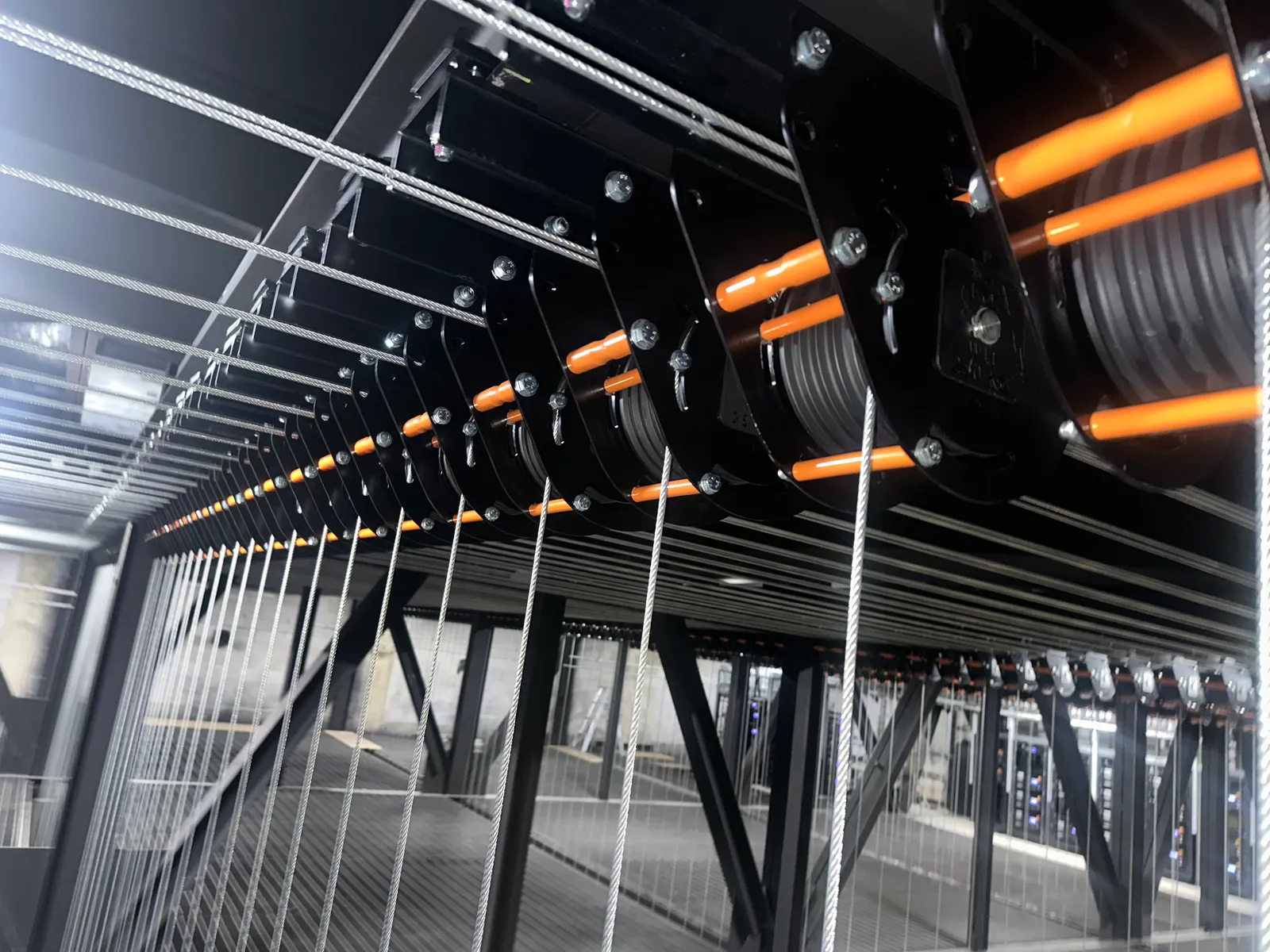
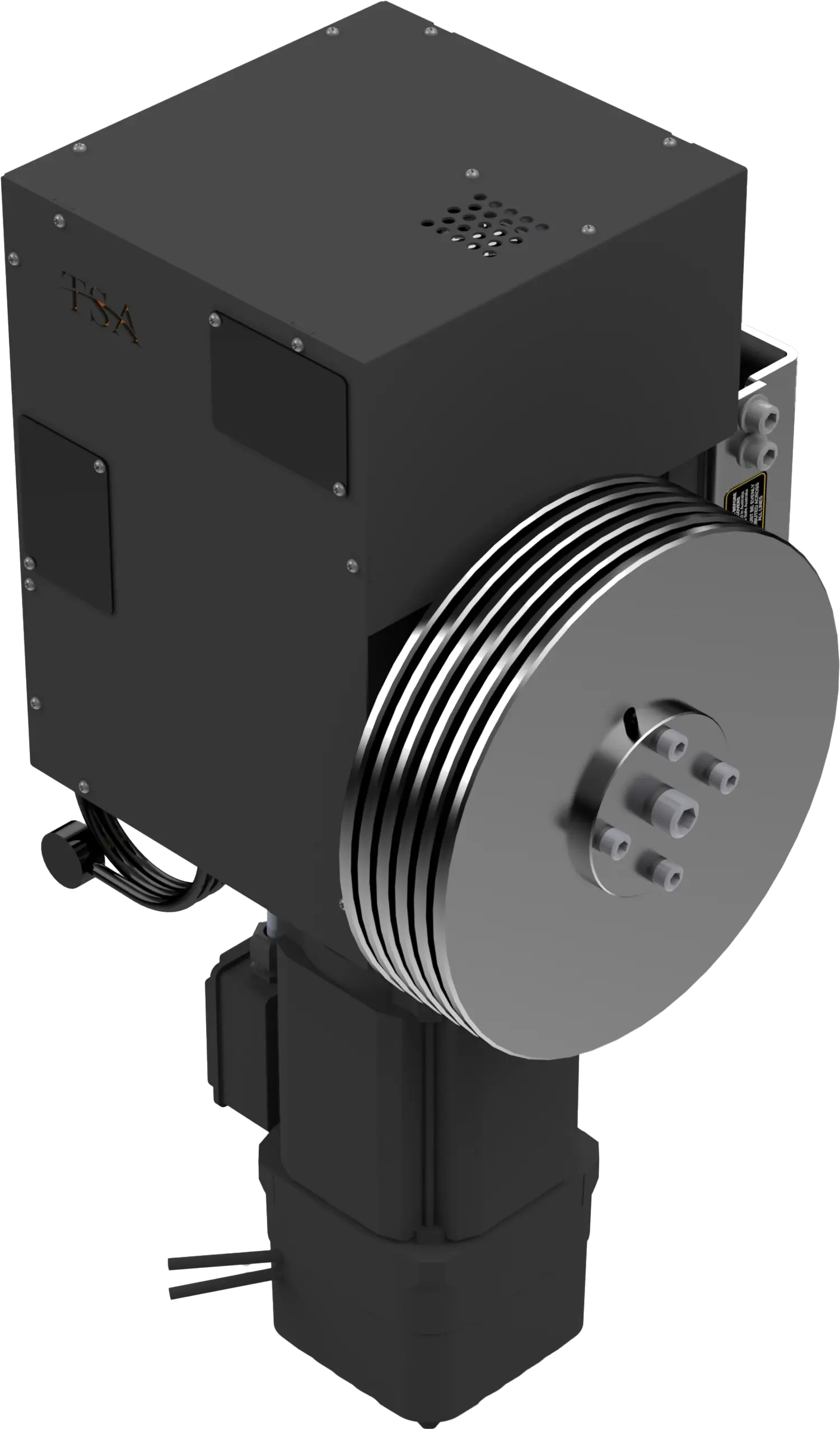
An electric pile-wind hoist on wire rope, permanently fixed to the wall or roof structure to fly a lighting or stage bar. Built for rooms where whoever presses the button is not a rigger. Ramped start and stop, roughly 8 m/min, very quiet, with an Up/Down push-button and E-Stop. Best for school halls, community and civic venues, theatres and PACs. Not for point loads or show cues: that is a chain hoist or a drum hoist.
Hercules Junior
- 500 kg
- Up to 15 m drift on six lines
- Variable to 0.5 m/s
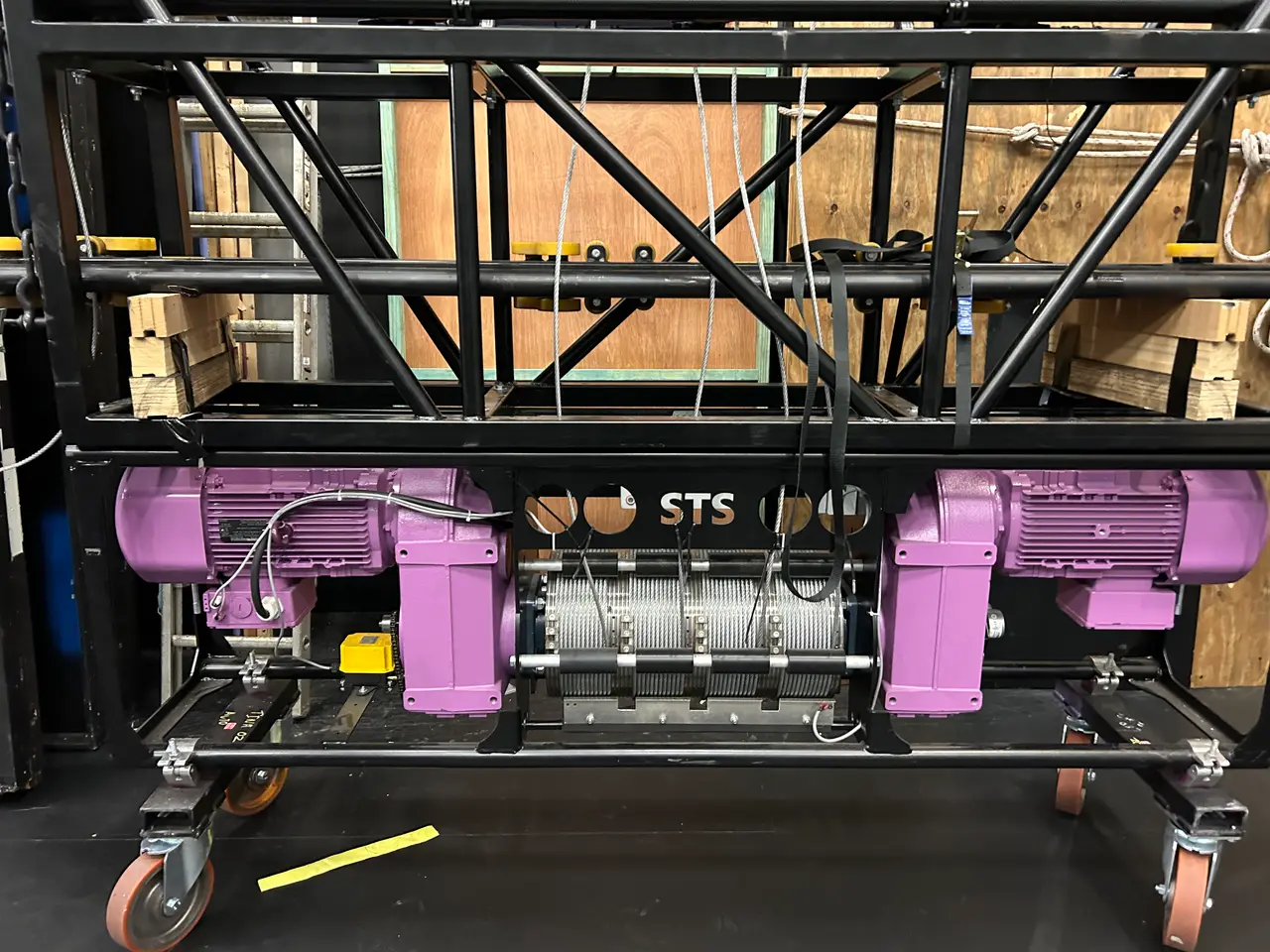
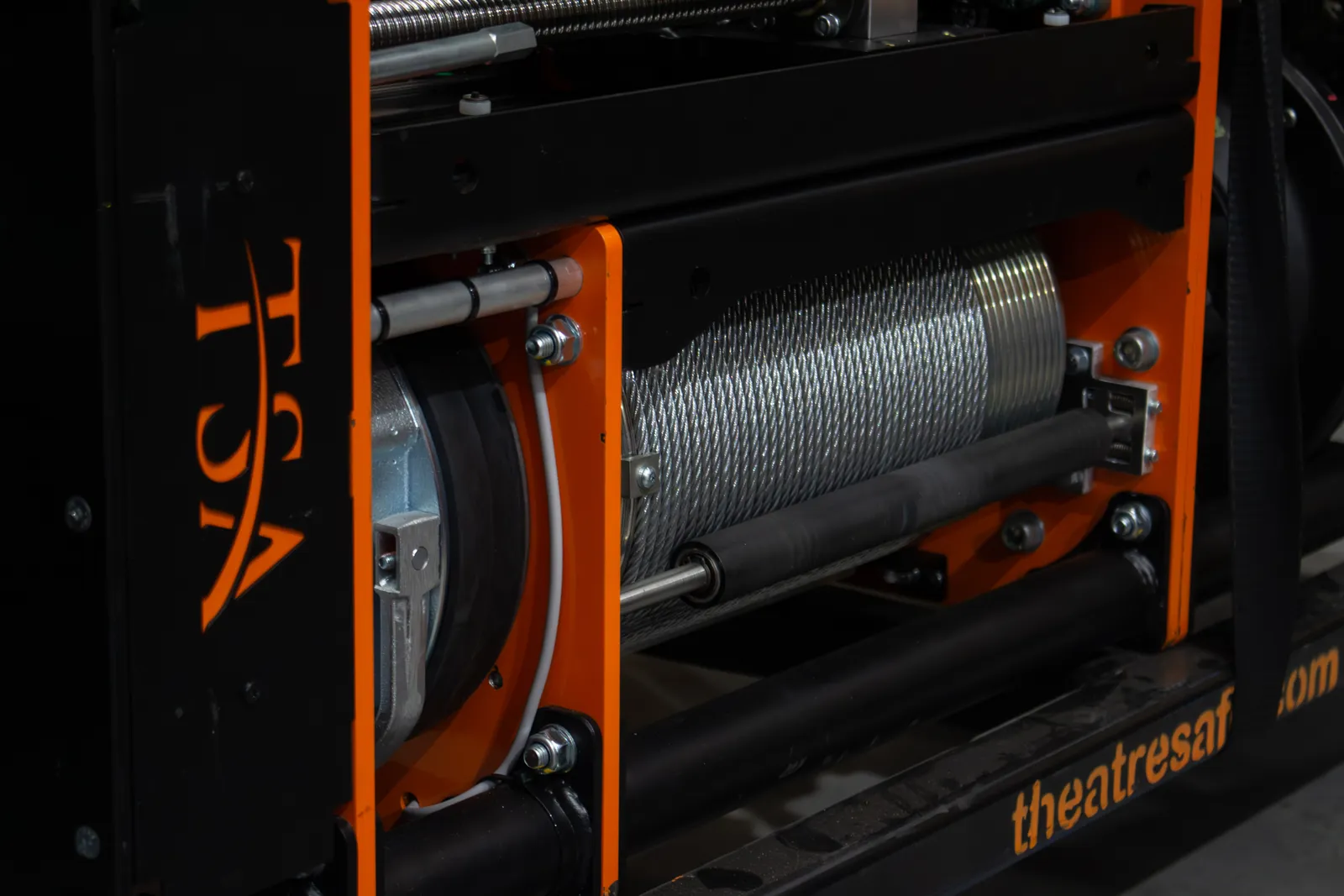
A drum hoist designed and built in Australia for theatre, not adapted from industrial lifting. This is the chapter-05 specification as a product: 8:1 safety factor, two independent brakes, dual encoders, cross-wire detection, SIL 3 capable. Best for small to medium venues, and any bar that moves on a cue.

Hercules Performer
- 150 kg at 50 Hz
- Up to 30 m drift
- Variable to 3 m/s
A high-speed drum hoist designed from scratch for performer flying - not adapted from stage, industrial or climbing equipment. Dual brakes that cannot actuate together, absolute and incremental encoders, and a manual brake release for lowering during a power outage. Best for flying people, on cue, repeatably.
And the bar itself
| Item | Rating | What it does |
|---|---|---|
| ILX theatrical lighting bar | 250 kg per 3 m section | Structural aluminium I-beam batten with power and DMX built in, so it arrives as one item instead of a pipe plus a loom plus a splitter. |
| Curtain winch | House tabs up to 60 m wide | Track-mounted capstan, virtually silent, flies with the bar it sits on. |
| Atlas control | One station to a networked rig | Runs it all, from a single up/down station up. Hoists, motors and controllers are rigging equipment and are specified together. |
See the fly systems page for how a full system comes together, or size a chain hoist with the Hoist Selector.
Whatever you fly it with, it gets inspected.
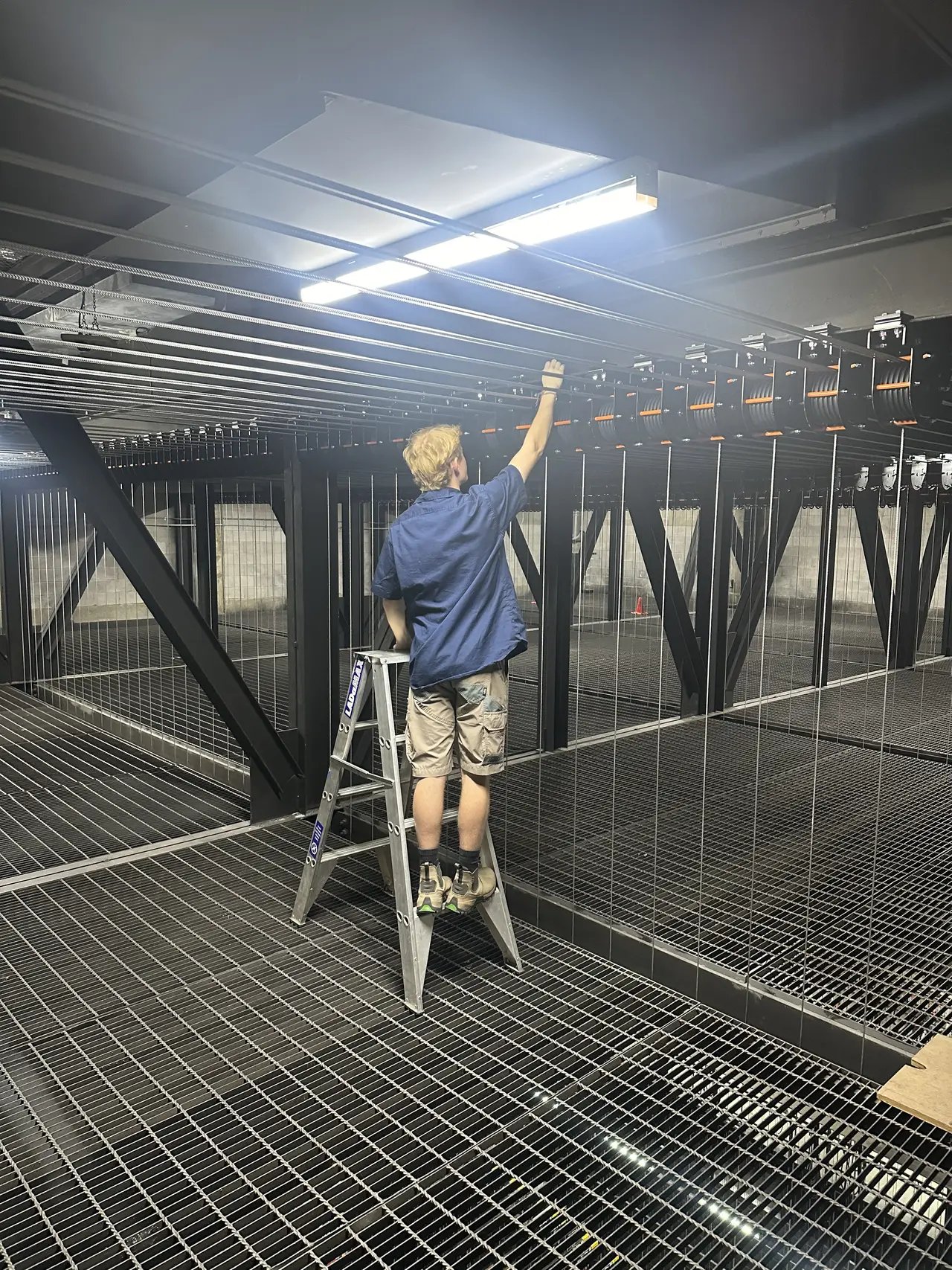
Manual or motorised, a flying system should be inspected annually by a competent person, in line with manufacturer guidance and the relevant Australian Standards. Every component of every set gets a compliance result, then a condition grade, so the report is something you can act on.
The method: visual, tactile and functional
-
Step 01
Visual
Every component checked against published discard criteria.
-
Step 02
Tactile
Hands-on for wear, looseness, deformation, alignment and corrosion.
-
Step 03
Functional
Brakes, limits and stops proven under power, where the set is powered.
-
Step 04
Recorded
Significant defects photographed. Minor maintenance (lubrication, tightening, small adjustments) done on the visit and recorded.
| Standard | Covers |
|---|---|
| AS 1418 | Cranes, hoists and winches series |
| AS 2089 | Sheave blocks |
| AS 2759 and AS 3569 | Steel wire rope |
| AS 4991 | Lifting devices |
| 50-plus standards | The full set a TSA inspection is assessed against |
| Grade | Result | Plain meaning | Action timeframe |
|---|---|---|---|
| A | Pass | Good working condition, well within limits | Routine |
| B | Pass | Good condition with signs of wear | Monitor |
| C | Pass | Worn but still serviceable | Monitor / adjust |
| Low | Fail | High wear or minor defects | 6-12 months |
| Medium | Fail | Exceeds discard criteria - replace or repair | 3-6 months |
| High | Fail | Condemned - remove from service | 0-3 months |
| In the report | What you get |
|---|---|
| Persistent Asset ID | The same block, rope or cradle tracked year on year, so the report shows condition history, not a fresh snapshot. |
| Maintenance Priority List | Assets grouped by urgency, a dated list you can budget against. |
| Due-diligence evidence | The whole document stands as evidence that the venue has met its obligations. |
The scoped version for a tower is a fly system inspection. The whole-of-venue version, covering every stage system, is the Venue Systems Health Check. Terms are defined in the TSA glossary.
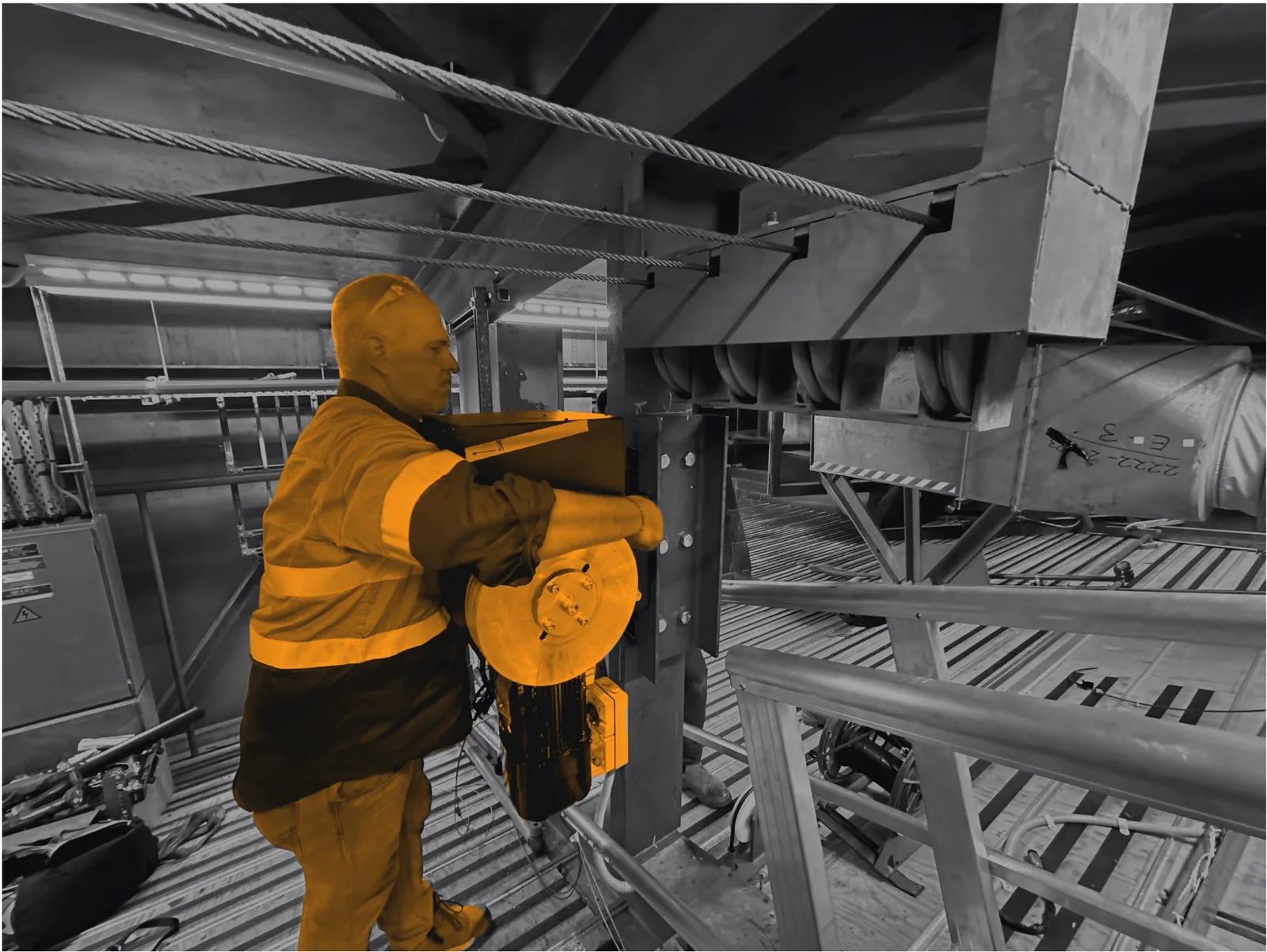
On the job
TSA designs and manufactures the hoists, bars and control here.
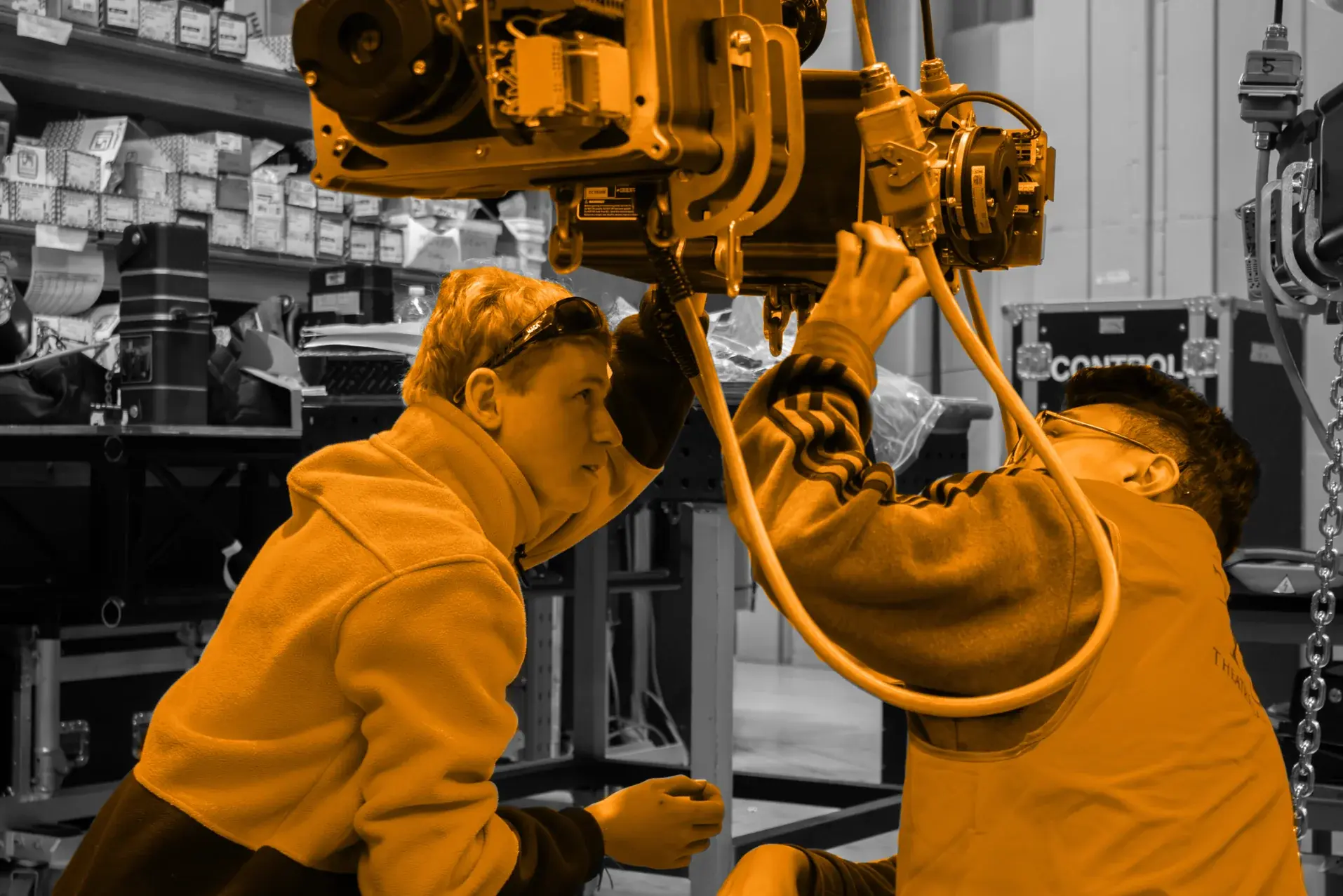
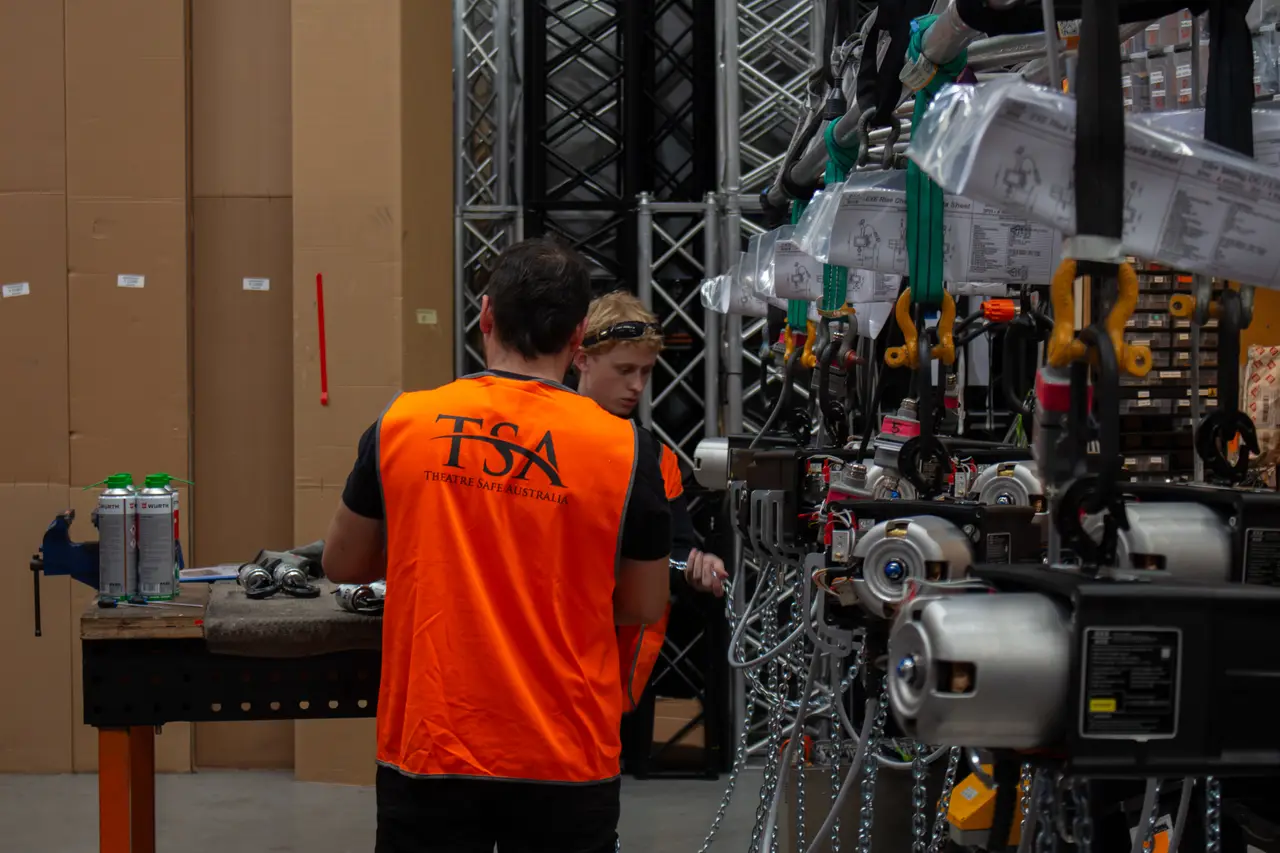
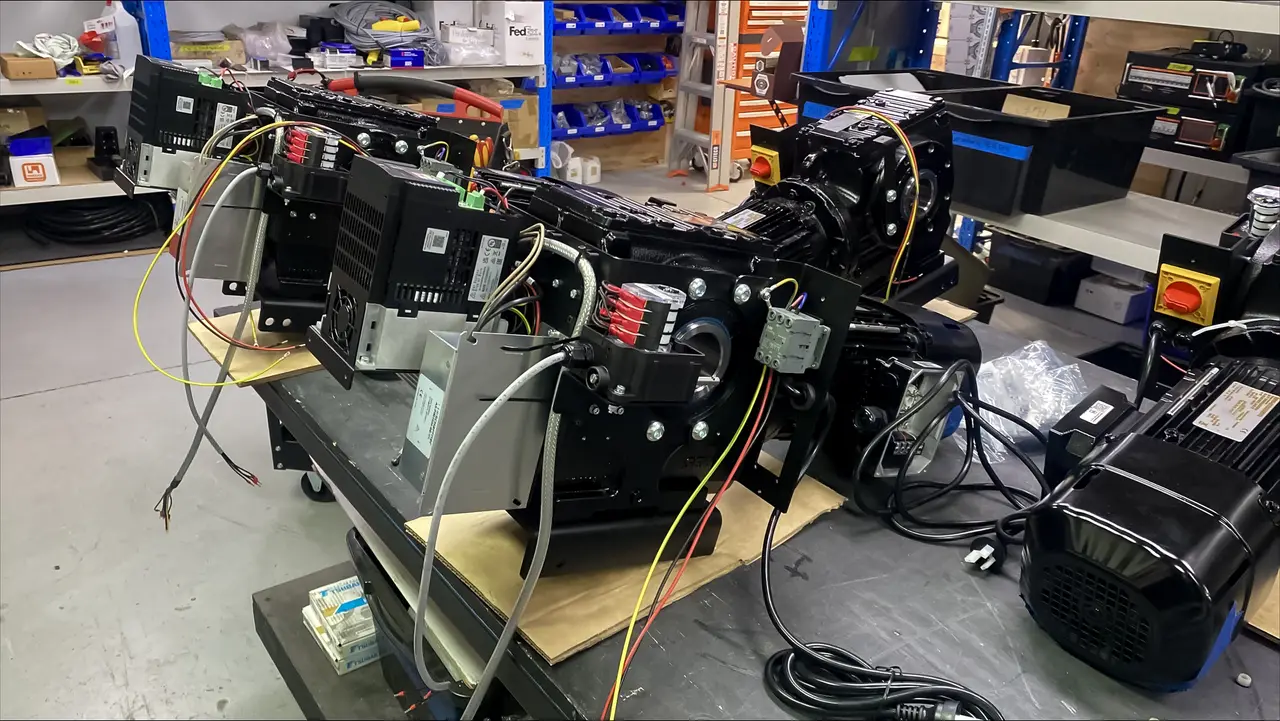
TSA workshop a hoist drive assembly, wiredWe make it. So we can still support it in year fifteen.
Most suppliers of stage flying equipment in Australia import it. TSA designs and manufactures the hoists, bars and control here, which changes what we can promise after the invoice is paid.
| Because we make it | In practice |
|---|---|
| The specification is a design brief | The 8:1 factor, second brake, absolute encoder and manual brake release are in because we decided they should be. |
| Odd jobs are variations | An unusual drift, an odd line count or a bracket that clears a heritage truss is a build variation, not a “no”. |
| Year-fifteen parts | The drawings and the tooling are here rather than on a container. |
| One accountable team | In-house teams install, integrate and come back to inspect: first drawing to annual report, Australia wide. |
| Your tower is | Start with |
|---|---|
| Manual, and the same few bars move every show | Motorise those sets: usually the shortest route to a safer bump. |
| Inherited, state unknown | An inspection, then work from the priority list. |
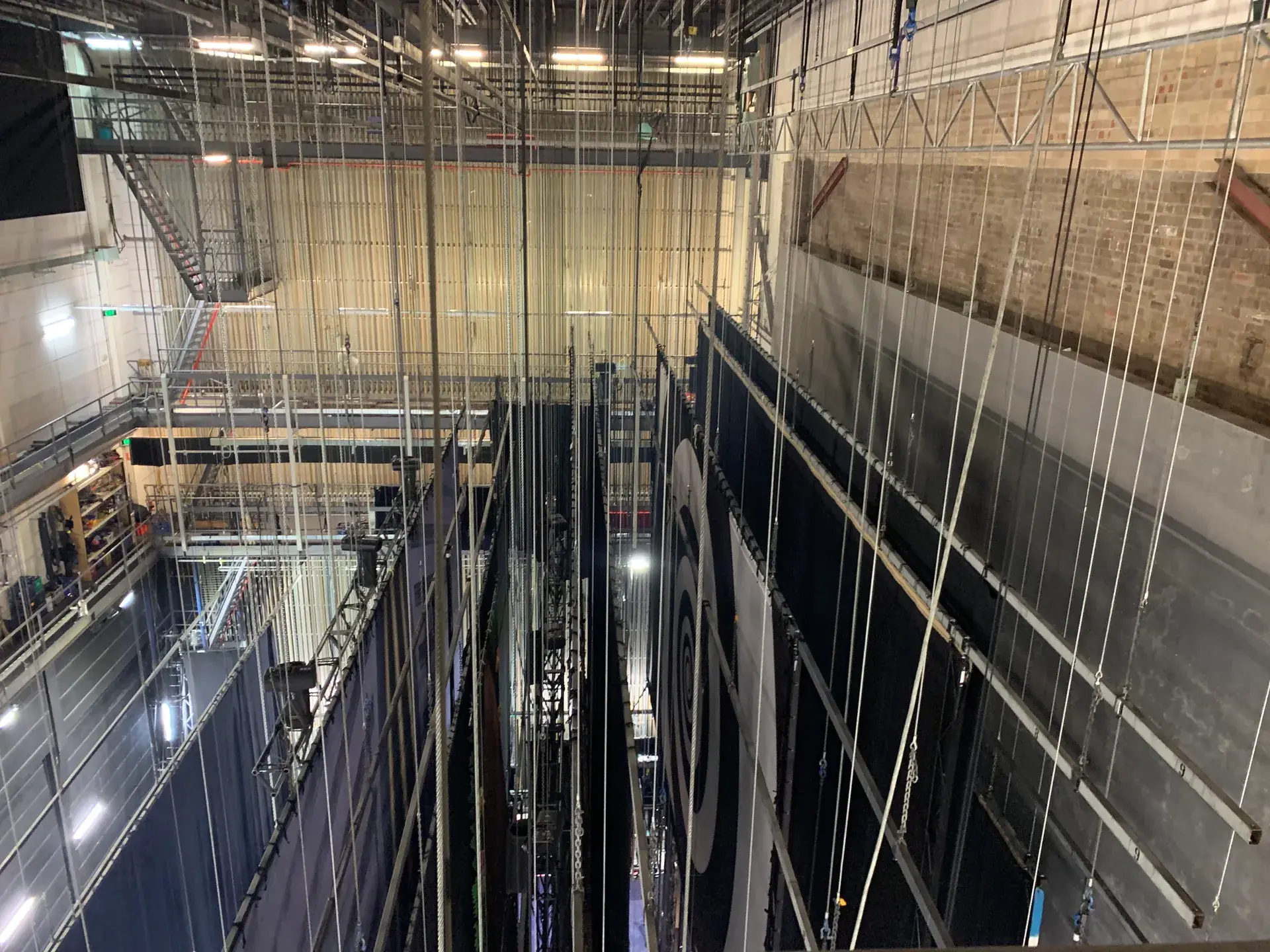
Counterweight sets, arbors and fly floors.
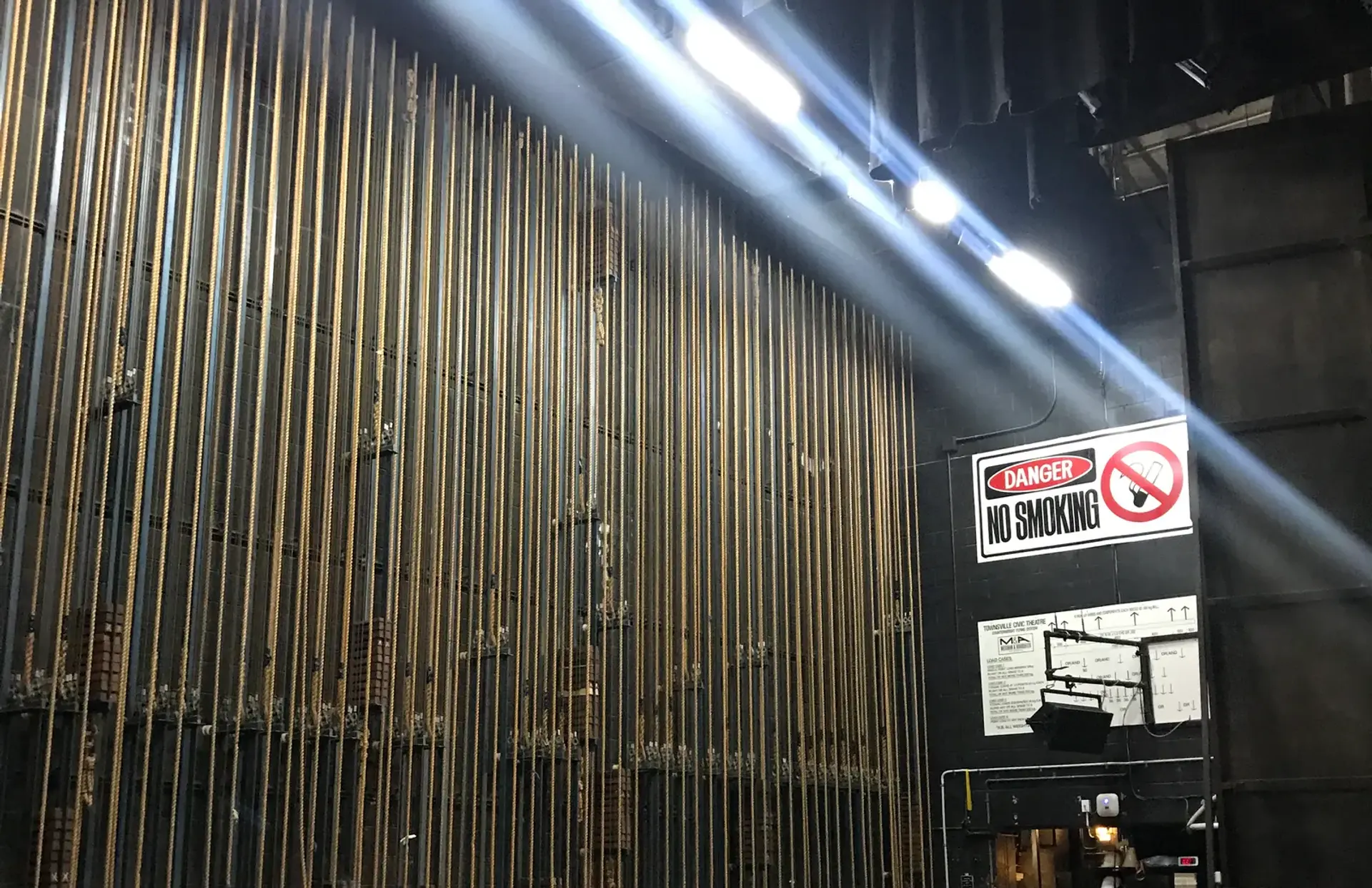
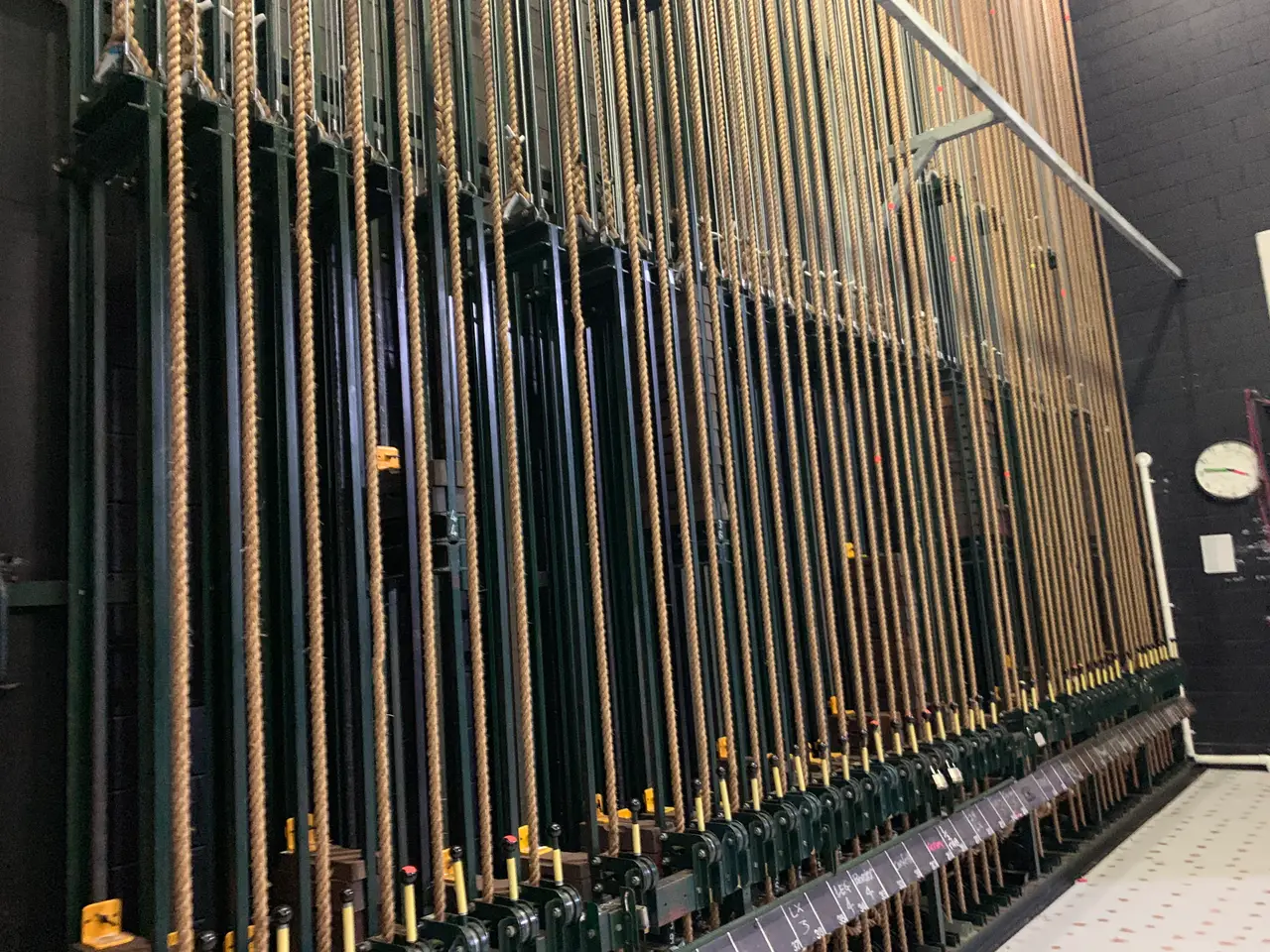
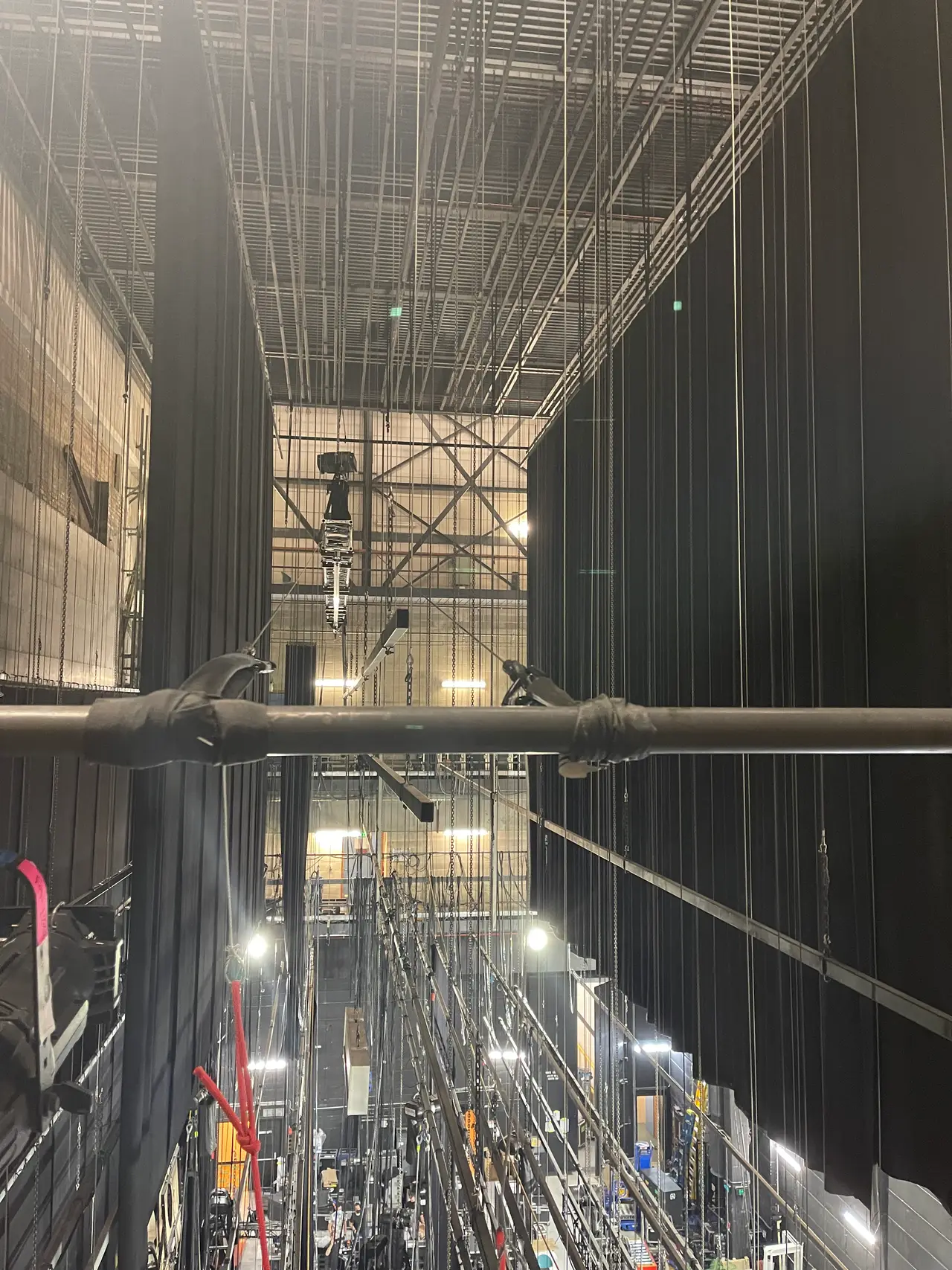
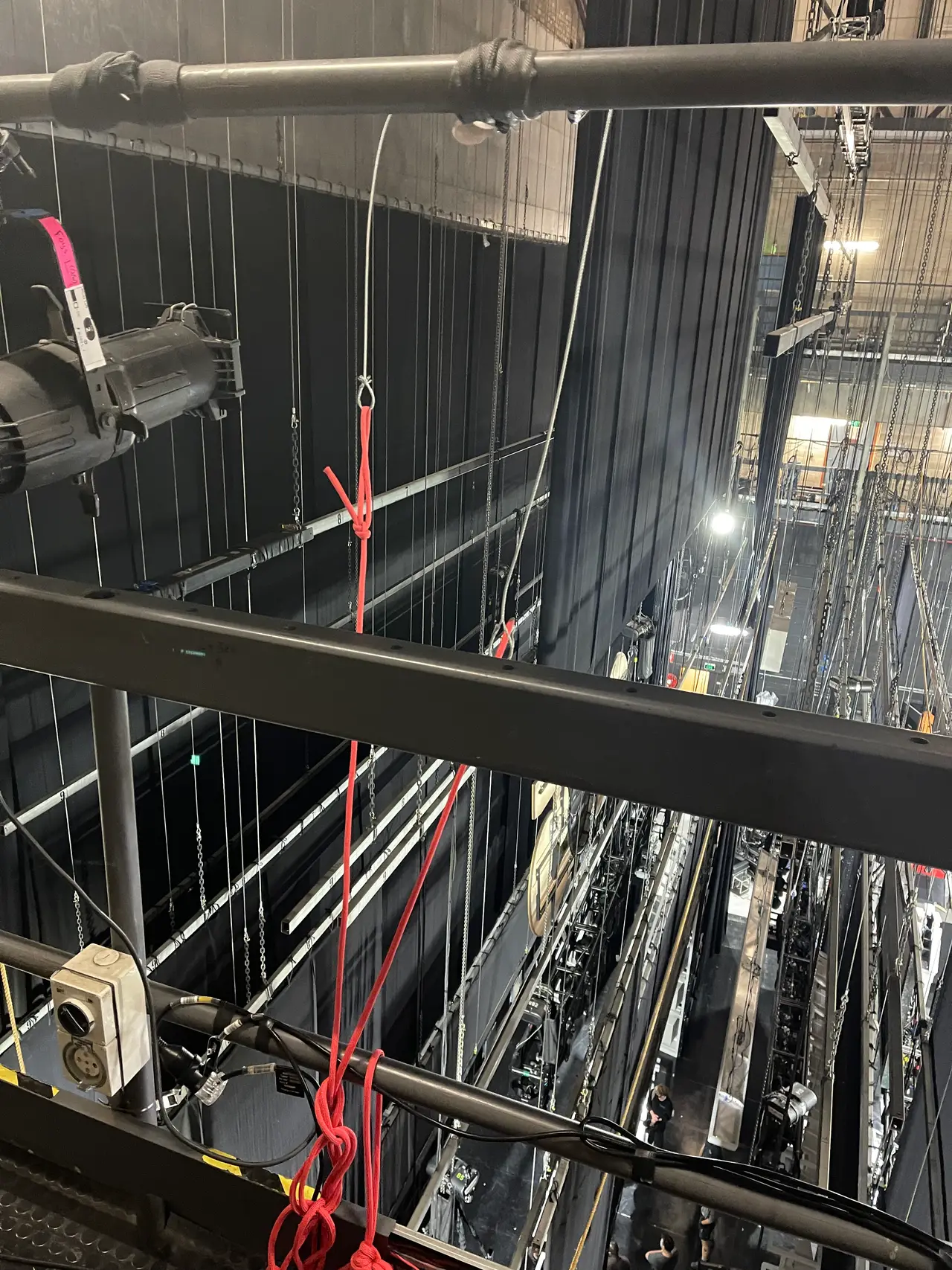
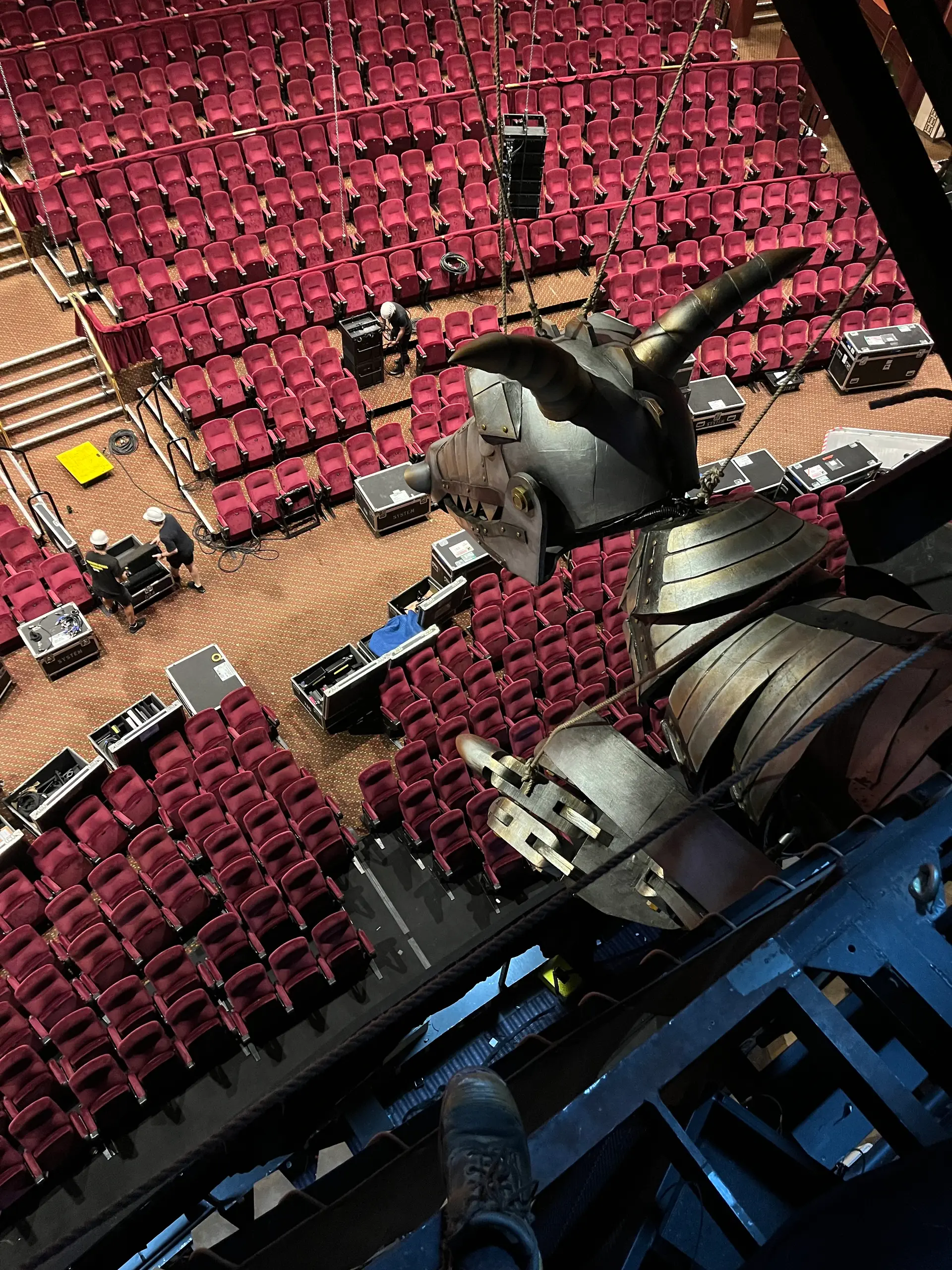
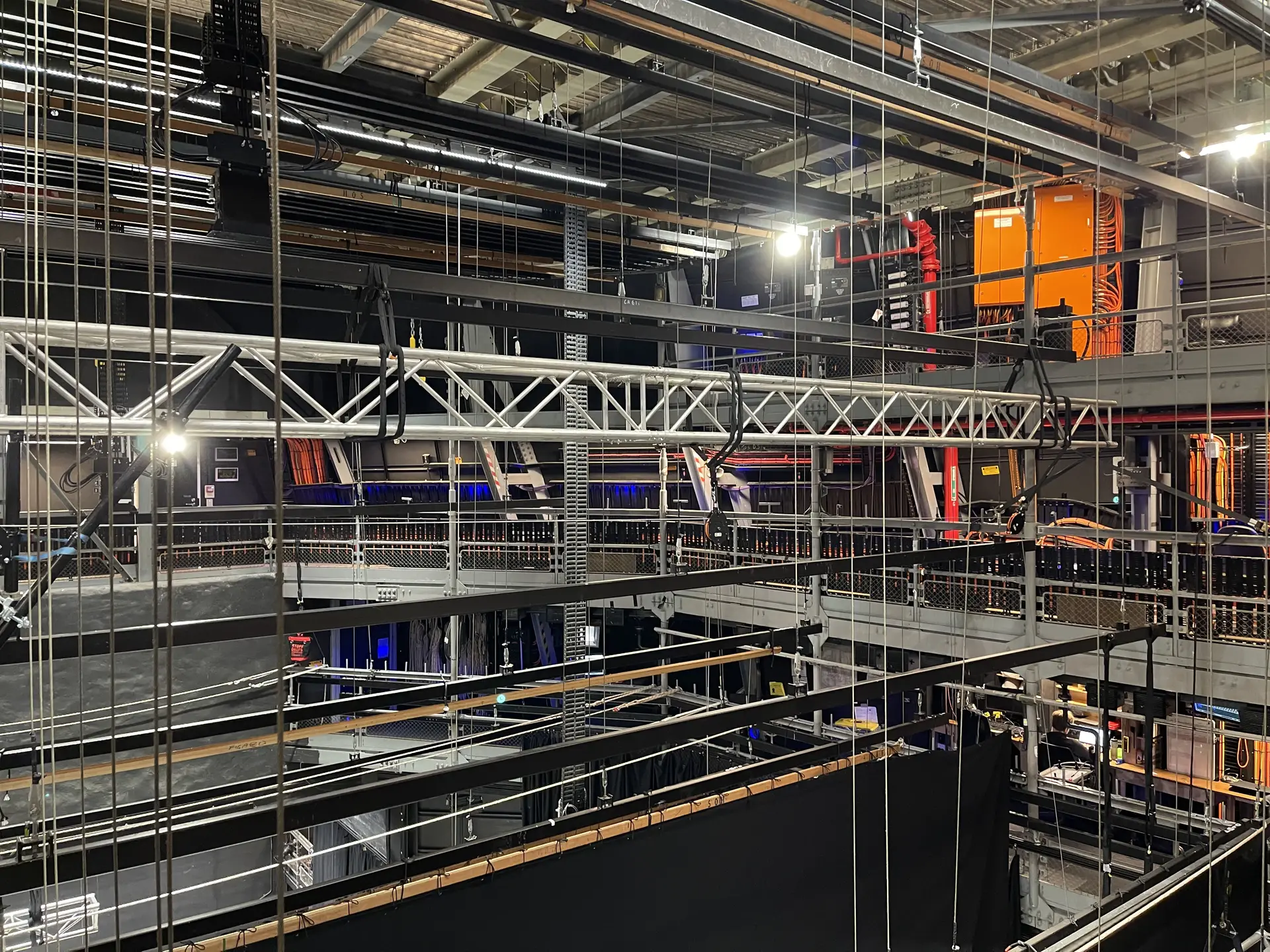
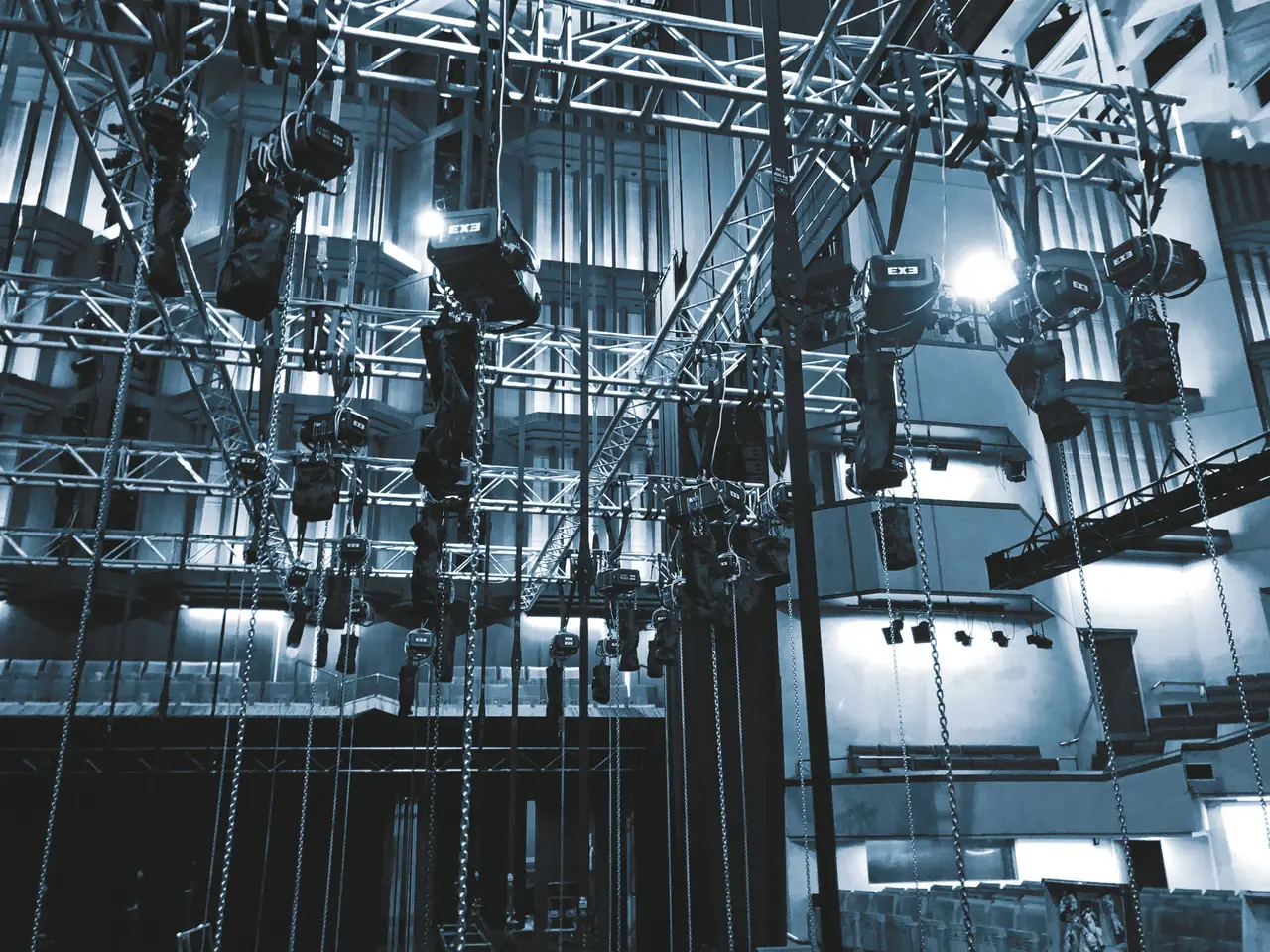
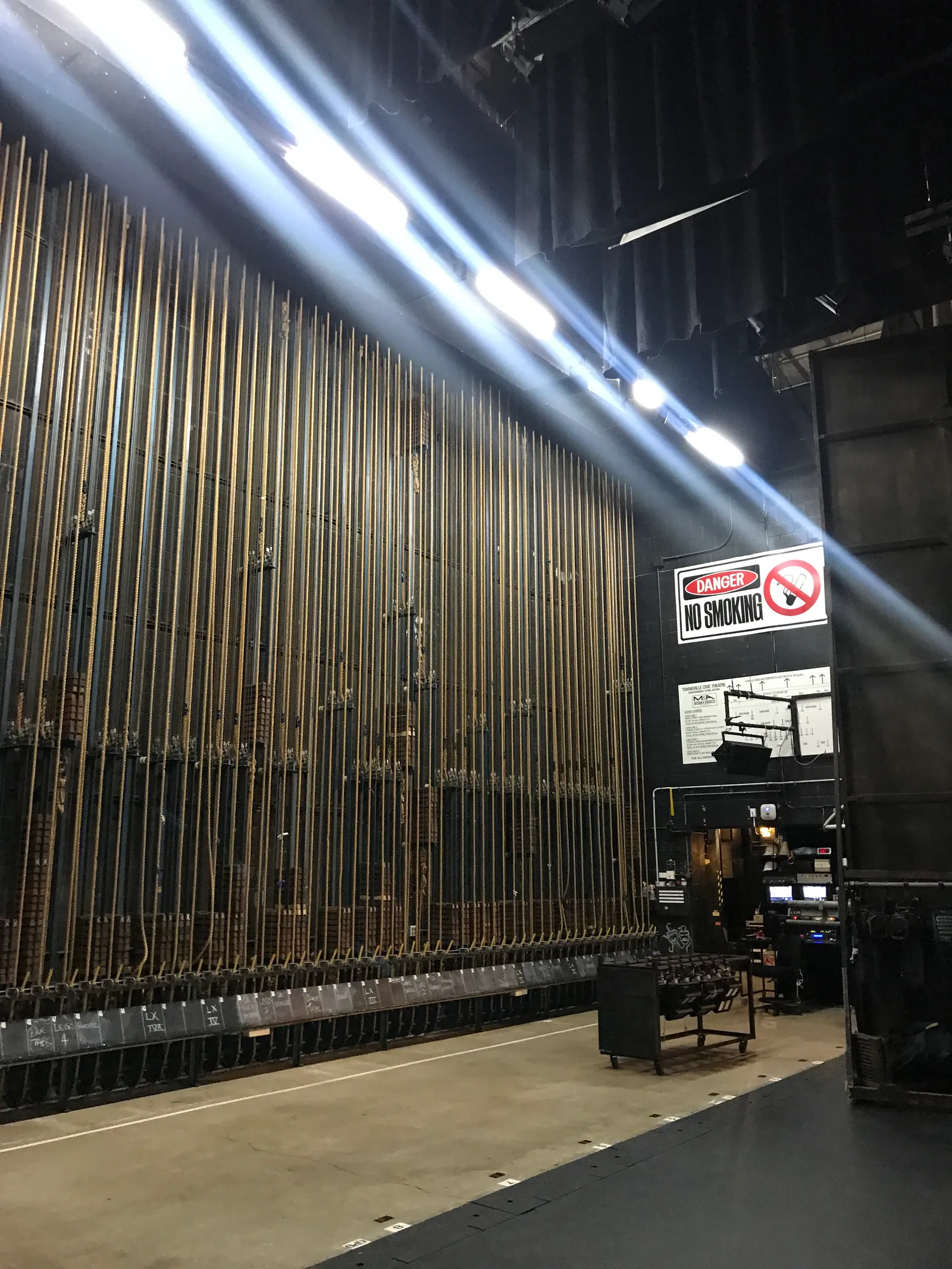
Counterweight sets, loft blocks, battens and fly galleries on real stages across Australia.
FAQ
Questions
Questions
about flying.
If your question isn't here, send us the detail of your tower and we will come back with the right answer for your room.
Call 1300 439 872 →
A batten hangs on lift lines that run up to loft blocks on the grid, across to a head block at the top of the tower, then down to a counterweight arbor. Steel weights are loaded into the arbor to match whatever is on the batten. Once the two sides balance, one operator can move several hundred kilograms by hand on the operating line, and a rope lock holds the set where it is left.
In single purchase the arbor travels the same distance as the batten and carries the same weight. In double purchase the batten travels twice the arbor distance, so the arbor carries twice the weight but only travels half as far - which keeps it high in the tower and leaves the wing space below usable. Double purchase is chosen where fly height or wing space is limited.
One where the weight in the arbor does not match the load on the batten, so the set wants to run on its own. It is the most common hazard on a counterweight system. Rebalance it at the loading gallery, and flag and lock the set off until you have.
Look past the load rating - most hoists meet the number they quote. Ask for an 8:1 safety factor, two independent brakes on separate parts of the drive train, a gearbox that will not backdrive if one fails, dual absolute and incremental encoders, cross-wire detection, mechanically set limits, independent certification to AS 1418, a manual brake release for power outages, and a manufacturer who will still hold parts in year fifteen. Chapter 05 is the full list.
Annually, by a competent person, in line with manufacturer guidance and the relevant Australian Standards. TSA carries out fly system inspections in-house with Competent Inspection Officers, grading every component and issuing a report that stands as due-diligence evidence.
Yes. A line set can be converted, or you can run a mixed rig - motorised on the bars that move every show, manual on the rest. TSA manufactures the equipment in Australia: pile hoists for fixed hall and PAC installs, Hercules Junior for bars that move on a cue, Hercules Performer for flying people. See fly systems for how a full system comes together.
Operating an existing, proprietary system using its standard method is generally not rigging as defined under WHS regulations - but it does require training on that system, site supervision and the venue's own procedures. Installing, altering or hanging from the system is a different matter. The line between the two is set out in rigging competency levels, and licensing differs by state.
Specifying a system, or working out what you already have?
Start here
Specifying powered flying
Book a Venue Systems Health Check.
One visit, one technician, a clear picture of every stage system you have and what to plan for. If the flying is the part you are worried about, a scoped fly system inspection goes deeper on the tower alone.
Book a Health CheckSee the flying gear we build.
Pile hoists, Hercules drum hoists, ILX bars and Atlas control - designed and manufactured in Australia to the specification in chapter 05.
Explore fly systems