


What happens after the sale: install, configuration, documentation, service, parts and support.
Article · Rigging
Updated 2 Jul 2026
Rigging
Buying guide
What to ask your hoist supplier about installation and ongoing support.
The kit is the easy part. Six questions decide whether your hoists are still working, and still certified, in year ten.
Installation ownership, venue configuration, handover documentation, service programme, spare parts, long-term support.
A supplier sells you a box. A partner is still on the end of the phone in year ten.
We specify, configure, install and service EXE Rise in-house. Australian stock. National service.
Service decides whether your hoist still works in year ten, and whether the paperwork is in order when the audit arrives.
The kit is the easy part.
Most chain hoists will lift a load on the day they arrive. What decides whether the investment holds up over ten years is everything around the hoist: who installs it, how it is configured, what paperwork comes with it, and who services it.
The six questions below are the ones worth asking before you commit. Each one separates a supplier from a partner.
Who owns the install?
Supplier, in-house team or contractor - and who do I call at commissioning?
Configured to my venue?
Chain length, mounting and control integration set for the room, not factory-standard.
What ships with it?
An individual test certificate per hoist, and the documentation you get at handover.
What does service look like?
A scheduled programme, what an inspection covers, and records of every visit.
Parts and turnaround?
Spare parts held in Australia, and the turnaround on a brake service or replacement.
Who do I call at year ten?
Whether the same team is still servicing it, and the relationship after warranty.
Who owns the installed result?
Installation can run three ways: the supplier does it, your in-house team does it, or your rigging contractor does it. None of those is wrong. What matters is that someone owns the final installed result, and that whoever you call at commissioning actually knows the equipment. The other half of the same question is configuration - chain length, mounting arrangement and control integration have to match your venue, not a factory default.
- Ask: can you install if I need you to, or supply for my team or contractor - and either way, who do I call if something is not right at commissioning?
- Ask: do you configure chain length, mounting and control integration for my venue, or does the hoist arrive in factory-standard trim?
The paperwork the audit asks for.
Entertainment venues run on traceable documentation: test certificates, load-path records, installation records. The time to confirm it exists is before purchase, not when an auditor is standing in your grid. Every hoist should arrive with its own certificate, tied to its own serial number.
Ask: does every hoist ship with its own test certificate, and what documentation do I receive at handover?
Who is still on the phone in year ten?
This is where a supplier and a partner separate for good. A chain hoist needs regular inspection - chain wear, brake condition, electrical connections, load testing. Brakes need adjustment; contactors eventually fail. The question is whether your supplier runs a structured service programme with documented findings, whether they hold parts in Australia rather than on an overseas lead time, and whether the same team is still there in ten years. The best answer to who do I call in year ten is the name of the company that installed it in year one.
- Ask: do you run a scheduled service programme, what does an inspection cover, and do you keep records of every visit?
- Ask: do you hold spare parts in Australia, and what is the typical turnaround on a brake service or component replacement?
- Ask: will your team still be servicing this equipment in ten years, and what does the relationship look like after the warranty period?
One team, start to year ten.
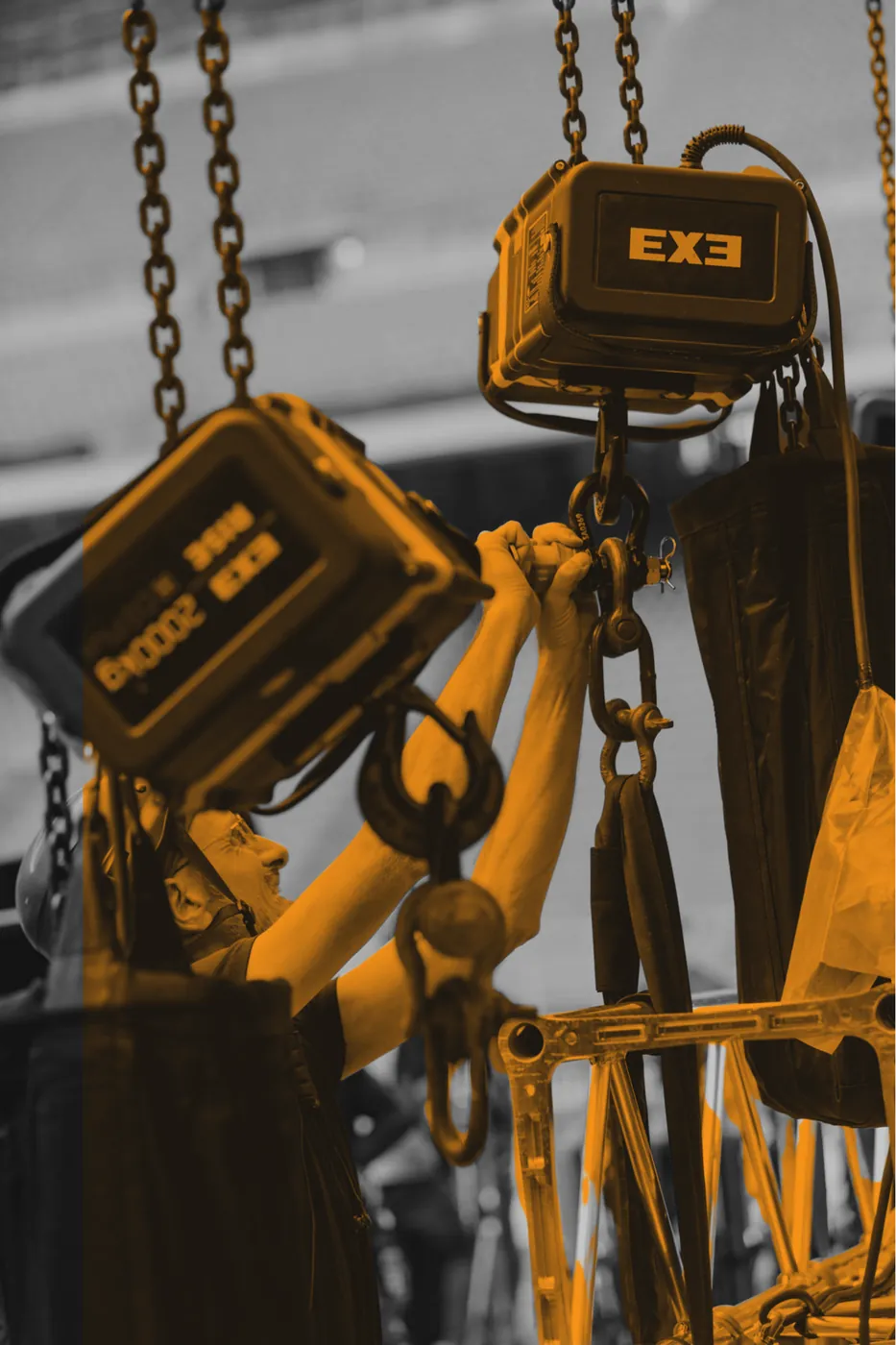
TSA supplies, configures, installs and services EXE Rise chain hoists as one in-house operation. The team that specifies your install is the team that services it through its life. We hold Australian stock, deliver service nationally, and keep the records that make an audit a formality rather than a scramble.
You are already running a venue. The point of asking these six questions is to make sure the answer, in year ten, is still a phone call away. We've got your stage.
Buying hoists you want supported for the long haul?
Free download
Get the EXE Rise Buyers Guide.
The full range, the D8 Plus decision framework, and the specs. We will email you the PDF.
Download form coming soon.
Hoist service & inspection.
Scheduled inspection, documented findings, Australian parts. The programme that keeps your hoists certified.
See hoist service