



Pull it by hand, draw it on a cord, or drive it on a motor? The right answer is set by the show, not the budget line.
Article · Drapes & Track
Updated 5 Jun 2026
Drapes
Drives & Control
How a stage curtain is driven.
Hand-drawn, corded or motorised - the drive decides the feel, the cueing and the crew. Here is how each one works, and where a Curtain Winch earns its place.
Manual is low-cost to own and quiet when it's quiet. Motorised is repeatable and cued. Corded sits between.
If a curtain has to hit the same mark on the same beat every night, hands won't do it. A drive will.
Spec the drive with the track and the drape. One system, sized to the load, quiet on cue.
Crew can draw a curtain beautifully on a good night. A motor draws it the same way on a bad one.
The drive is the decision that ages.
You can change a drape in an afternoon. The drive is harder to change once it is in - it sets the cabling, the control, the wing layout and the crew the show needs. So it is worth getting right at spec, not after the first season of fighting it.
There are three ways a stage curtain is driven, and the honest question that separates them is simple: does this curtain have to hit a cue? If it sits in one place all season, hands are fine. If it has to open on a downbeat, close on a blackout, and do it the same way every night, you are into powered territory.
Three ways to move a curtain.
Most stages run more than one. Here they are side by side, matched to the job each curtain actually does.
| Drive | Cost to fit | Cue capability | Noise | Speed | Crew per move |
|---|---|---|---|---|---|
| Hand-drawn | Lowest | None, set by hand | Silent | Walking pace | One per side, on the deck |
| Corded | Low to mid | Live, operator-judged | Quiet | The operator's pace | One operator, from the wings |
| Motorised | Highest up front | Repeatable, on the cue | Quiet, engineered | Set and consistent, to 1.1 m/s | None, runs from a controller |
The Curtain Winch, explained.
When a curtain needs to move on cue and stay quiet doing it, this is the drive we reach for. A capstan drive works on grip, not gears on the curtain: the motor turns a grooved capstan, the endless haul line wraps around it, and as the capstan turns it draws the line - and the master carrier with it - along the track.
Our Curtain Winch is rated to 300kg, runs at speeds up to 1.1 m/s (fixed on the CW-1, infinitely variable on the CW-1V), and is virtually silent in the room. It takes dry-contact control that ties straight into Crestron or QSys, or runs off a simple pendant - and it travels on our Triple E E-Rail and UniBeam track.
Opens and closes on a loop - drag to scrub
Hover a part - or drag the slider to travel the drape.
What "on cue" really needs.
A motor on a track is not the whole job. Cue-ready means five things working together.
- Soft start and stop - so the curtain eases into the move and settles, instead of snatching the fabric or the audience's eye.
- Repeatable end-stops - the same open and the same close, set once and held every show.
- E-stop and limits - the curtain stops when it must, and never runs past where it should.
- Control integration - dry contact into Crestron or QSys, or a simple pendant in the wings.
- Speed control - fixed on the CW-1, infinitely variable on the CW-1V, matched to the cue.
A drive without these is a motor. A drive with them is a cue you can trust.
Five questions before you motorise.
Motorising is not always the answer. If a curtain never has to hit a cue, hand-drawn or corded is the honest call - lower cost to fit, and silent in the room. These five questions settle whether a powered upgrade earns its place, and what it needs to be if it does.
Does it have to hit a cue?
If yes, you are past hand-drawn.
What is the finished drape weight?
The drive is sized to the load, not guessed.
Does it need to be silent in the room?
A capstan drive is virtually silent where others are not.
How does it talk to your control?
Dry contact, pendant, or full Crestron / QSys integration.
Who installs and certifies it?
A motorised rig is a working-at-height install.
We've got the drive. You call the cue.
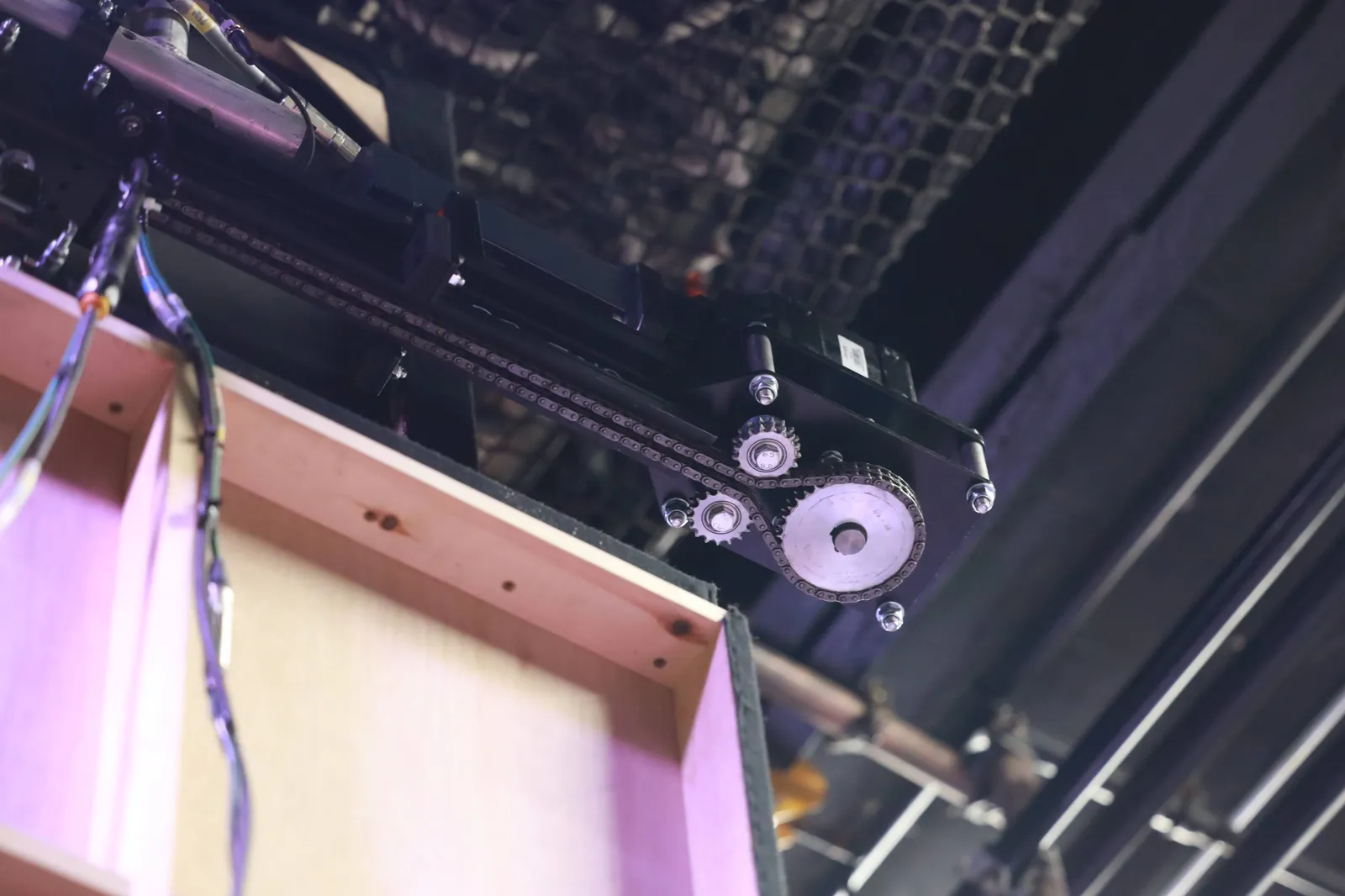
Our Curtain Winch is made in-house - a capstan drive rated to 300kg, up to 1.1 m/s, virtually silent, with dry-contact control into Crestron or QSys.
It runs on our exclusive Triple E track, and we spec the drive with the track and the drape rather than bolting it on afterwards. We install and certify in-house.
If you have a manual or corded curtain you are thinking of powering, a Venue Systems Health Check tells you whether the existing track and rig will carry a drive, or what needs to change first. Not sure where to start? The Drape Selector walks the spec with you.
We've got the drive. You call the cue.
Ready to put your curtains on cue?
Free download
Get the drapes catalogue.
Every fabric, finish and track-compatible drape in one PDF - emailed straight to you.
Curtain track, winches & hardware.
Triple E track and the in-house Curtain Winch - manual, corded or motorised, specified as one system.
Browse track & hardware