


What do IFR, DFR and NDFR actually mean - and which one is hanging in your venue right now?
Article 04 · Drapes
Updated 12 May 2026
Drapes
Compliance
What fire ratings actually mean for stage drapes.
IFR, DFR and NDFR decoded against AS 1530.2 - with the retreatment cadence and audit-ready signals your venue manager wants in writing.
AS 1530.2 vertical burn test. Flammability Index at or under 10 AU / 6 NZ.
Water, paint, salt air or wet cleaning compromise FR on NDFR fabrics - long before the drape looks damaged.
Treatment certificate at handover. Retreatment tracked. Audit-ready, every season.
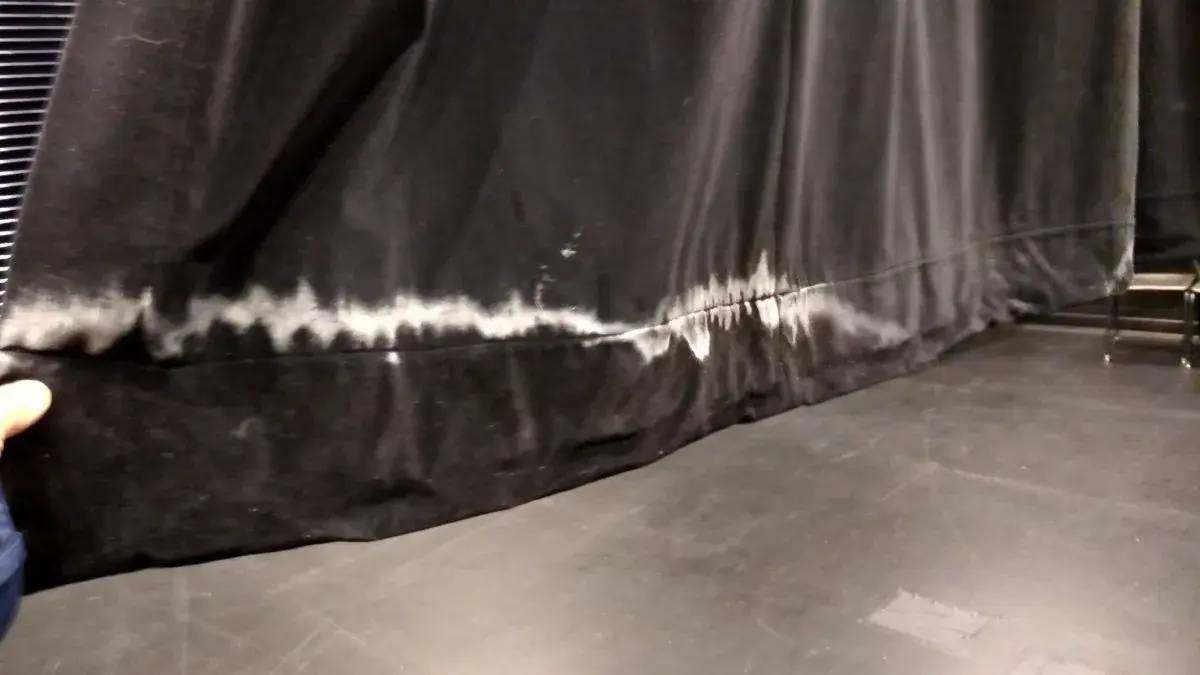
Salt tide marks on the bottom edge of a black drape are the single most common FR failure signal we see on inspection.
The standard your stage drapes are tested against.
The Australian standard for testing flammability of theatre soft goods is AS 1530.2, the vertical burn test. A fabric sample is held vertically, exposed to a flame, and assessed on how quickly it ignites, how it self-extinguishes, and how much char and afterglow remains. The result is reported as a Flammability Index.
A drape carrying a current AS 1530.2 certificate at or under the threshold is the baseline a venue should be working from. Anything above that - or anything without a certificate - sits outside compliance regardless of what the fabric looks like.
For full system context, AS 1530.3 covers ignitability, flame propagation, heat release and smoke release, and is used alongside AS 1530.2 for broader compliance assessment.
IFR · DFR · NDFR.
The three categories, decoded.
Three letters in front of "FR" tell you almost everything that matters about how a drape behaves under flame - and how long it stays compliant. Here is what each one means, what carries it, and what kills it.
How a durable or non-durable treatment is applied to the cloth in the first place is documented on the Reveal Productions fire-treatment page.
IFR
Flame resistance is built into the fibre itself. It is not a coating. It does not wash off, weather off, or degrade with normal use.
Common examples
Wool serge, velvet (fibre-dependent), polyester velour, sheer voile, PolyCyc cyclorama cloth.
Retreatment
None required for the life of the fabric. The FR rating itself does not expire.
What kills it
Physical wear, contamination, or repeated heavy soiling that compromises the fibre structure.
DFR
A chemical FR treatment applied to the fabric, engineered to survive multiple wash and use cycles before retreatment.
Common examples
Blockout linings such as RevPro Blockout, and some heavier polyester blends.
Retreatment
Specified per product - generally measured in wash cycles or years of service.
What kills it
Repeated wet cleaning beyond rated cycles, prolonged moisture exposure, abrasion.

NDFR
A surface FR treatment. Performs its job until water, paint or wear strips it off.
Common examples
Turo molton, filled cloth, sharkstooth gauze, Nessel canvas (when treated).
Retreatment
Typically every 2 to 3 years under normal use. Sooner if wet, painted, or heavily handled.
What kills it
Moisture, cleaning, paint, dye, dragging across damp floors.
The drape still looks fine. The certificate doesn't.
Salt tide marks on the bottom edge of a black drape are the single most common FR failure signal we see on inspection. They mean the drape has been wet at some point - condensation, a leak, a damp floor, salt air.
On an NDFR fabric, the treatment has likely been compromised at that line. The drape may still hang well, look fine under stage lights, and pass a casual glance - but it is no longer the fabric the certificate was written for.
That is the failure mode that bites venues at audit. Not visible damage. Compromised FR on a drape that still looks correct.
How long does the rating actually last?
This is where what fire ratings mean for stage drapes stops being academic and starts costing money at audit. For IFR fabrics, the certificate documents the inherent property of the fibre - it does not expire as a retreatment trigger. For DFR and NDFR fabrics, certificates are time-bound or cycle-bound.
Most NDFR drapes are recommended for retesting and retreatment every 2 to 3 years, or after any of the following:
- Water exposure - cleaning, leak, condensation, salt air contact
- Paint or dye application
- Visible salt tide marks or fading at the hem
- Heavy soiling that requires wet cleaning
- A previous certificate older than 3 years with no interim inspection
If your venue cannot answer when those drapes were last tested, the drapes are due now.
The next time someone sells you drapes, ask these five questions.
If the answer to any of these is hesitation, or "I'll get back to you", that is the answer.
Is the fabric IFR, DFR or NDFR?
If they do not know, that is the answer.
What is the Flammability Index under AS 1530.2?
Should be at or under 10 for Australian venues, at or under 6 for New Zealand.
Will I receive a treatment certificate at handover?
Insurance needs it. So does any compliance audit.
What is the retreatment schedule?
Get the cadence in writing, not over the phone.
What invalidates the FR rating?
A supplier who can answer with specifics has thought about the after-sale.
One visit. One report. Clear direction.
TSA's stage drape range covers all three FR categories - IFR by default on our wool serge, velvet, sheer voile and PolyCyc lines, with DFR and NDFR options where the brief calls for them.
Every drape we manufacture is supplied with an AS 1530.2 treatment certificate at handover, and our service and inspection programme tracks retreatment dates so venues are not caught short at audit.
If you want a second set of eyes on what is already hanging in your venue - what is compliant, what is about to fall outside, and what needs retreatment before the next show - we run that as part of a Venue Systems Health Check.
We've got your stage. You've got your show.
Ready for a straight answer on what's hanging in your venue?
Free download
Get the drapes catalogue.
Every fabric, every weight, every FR rating in one PDF - emailed straight to you.
Stage drapes, scrims & soft goods.
Wool serge, velvet, PolyCyc, blockout, sharkstooth - IFR by default where the fibre allows.
Browse drapes at TSA